Limited space doesn't have to mean discomfort or a lack of professionalism. Well-designed small spaces are often more efficient than large, poorly organized open-plan areas. This is a fact that proves itself project after project.
The current context amplifies the challenge. Very small businesses and startups are growing in limited spaces. Teleworking and satellite offices are on the rise. Coworking spaces and shared offices are proliferating. Small professional spaces are multiplying and affecting an increasing proportion of the workforce.
In 45 years of manufacturing professional furniture, buronomic has designed collections adapted to all configurations, including constrained spaces. Compact desks, modular solutions, storage designed to optimize every square meter: the range covers all needs, without compromising on quality or durability.
This article offers a comprehensive overview: the golden rules of space planning in small spaces, the dimensions to respect, 7 furniture tips to save space, the perfectly suited office furniture products, and the mistakes to avoid.
Before furnishing, plan ahead: the essential steps
Measure precisely and draw the plan to scale
The first step, often rushed, is always crucial. Measure all the walls and identify any constraints: windows, electrical outlets, doors, columns, alcoves. Draw a scale plan including circulation spaces before placing any furniture.
Look for untapped "dead zones": corners, spaces under windows, hallways, alcoves. The golden rule is simple: the dead zones of a small space are often its best assets, provided you know how to use them.
Define the actual uses before choosing the furniture
Several key questions to ask oneself.
- How many simultaneous workstations?
- Are there any needs for an on-site meeting?
- Should we receive clients?
- What proportion of work is done on documents compared to computer work?
A standalone computer workstation requires a minimum of 120 cm in width and 70 cm in depth. A workstation with customer reception requires a return or a side table.
The classic mistake: buying furniture before answering these questions, then getting stuck in traffic.
The minimum distances to be respected for a compliant and comfortable space
| Space | Minimum | Recommended |
| Passage behind the seat | 80 cm | 100 cm |
| Main traffic aisle | 90 cm | 120 cm |
| Between two opposing positions | 120 cm | 150 cm |
| In front of a wardrobe or storage unit | 80 cm | 100 cm |
| Free space under the desk (legs) | 75 cm | 80 cm |
7 Buronomic tips for setting up a professional office in a small space
These 7 tips are ranked by impact. The first three apply to all small professional spaces, regardless of their layout.
Tip 1: Choose a desk of the right size, neither too big nor too small
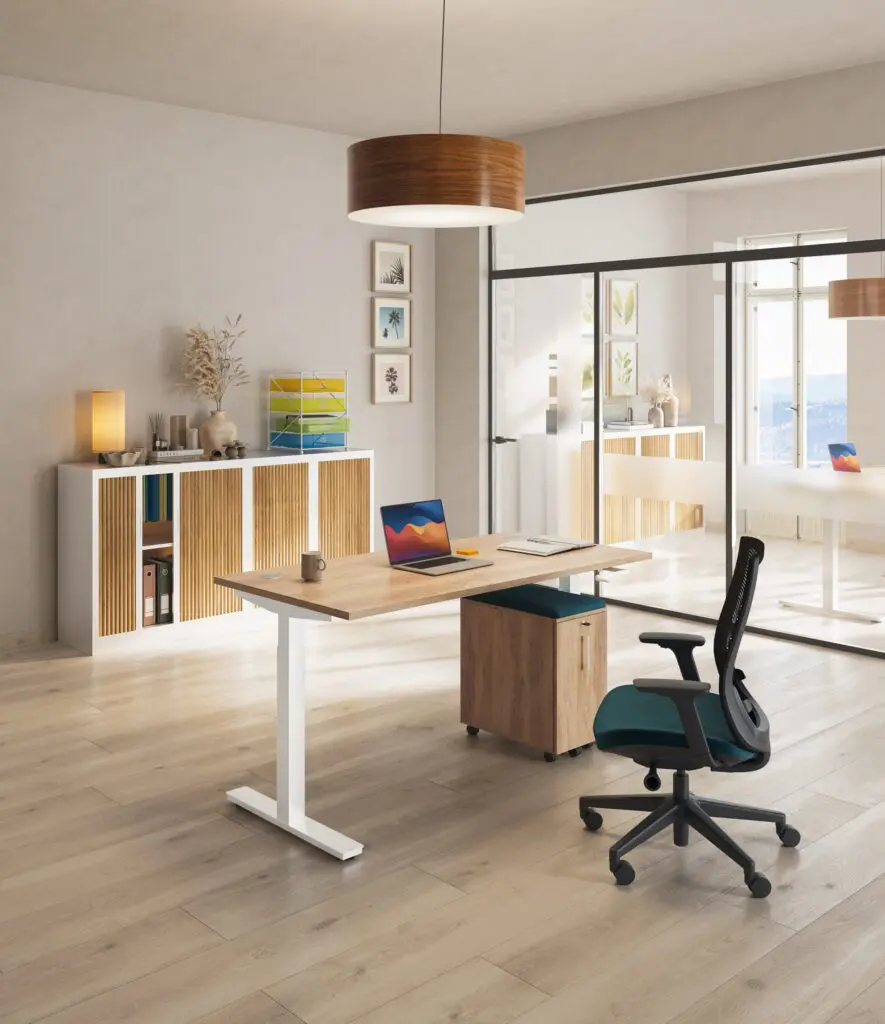
The most compact and efficient desk measures 120 x 70 cm. This is sufficient for a laptop setup without a dual monitor. For use with a fixed monitor, allow at least 120 x 80 cm. For a dual monitor setup, you will need 140 to 160 cm wide and 80 cm deep.
A common mistake is typical: choosing a 180cm desk for a 12m² room. This leaves no space left to move around.
Mechanically adjustable desks are available from 120 cm, the most compact width in the range. A depth of 80 cm is standard across all models. Several coordinated finishes are available.
Tip 2: Utilize vertical space with tall storage units
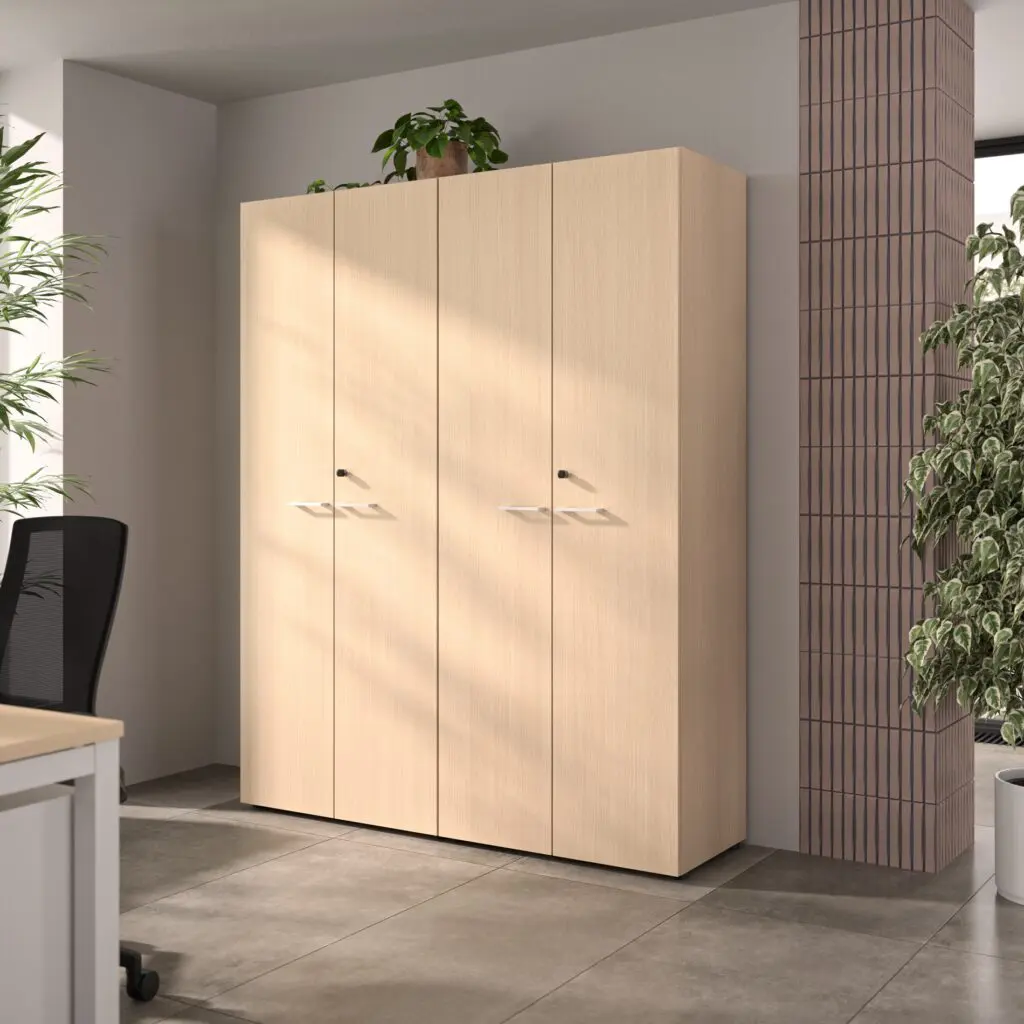
In a small space, every square meter of floor space is precious. Wall space, on the other hand, is free. Opt for tall storage units rather than low ones, which take up floor space.
One limit to respect: do not exceed 180 cm in height for storage accessible without a stepladder.
The professional cabinets are available in several heights (72 cm / 104 cm / 136 cm / 201 cm) and widths, depending on the configuration. The finishes are coordinated with the desks in the range.
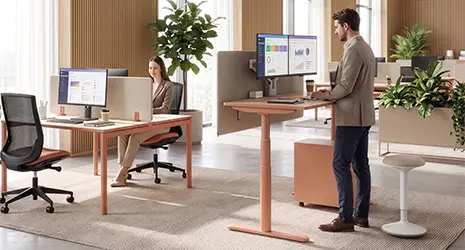
Tip 3: Opt for a height-adjustable desk to gain comfort without gaining space
A sit-stand desk doesn't take up any more space than a traditional desk. But it significantly improves comfort in a confined space where movement is limited. Alternating between sitting and standing reduces fatigue associated with remaining still in a small area.
In a small individual office space, the electric desk is the best possible ergonomic investment for the same surface area.
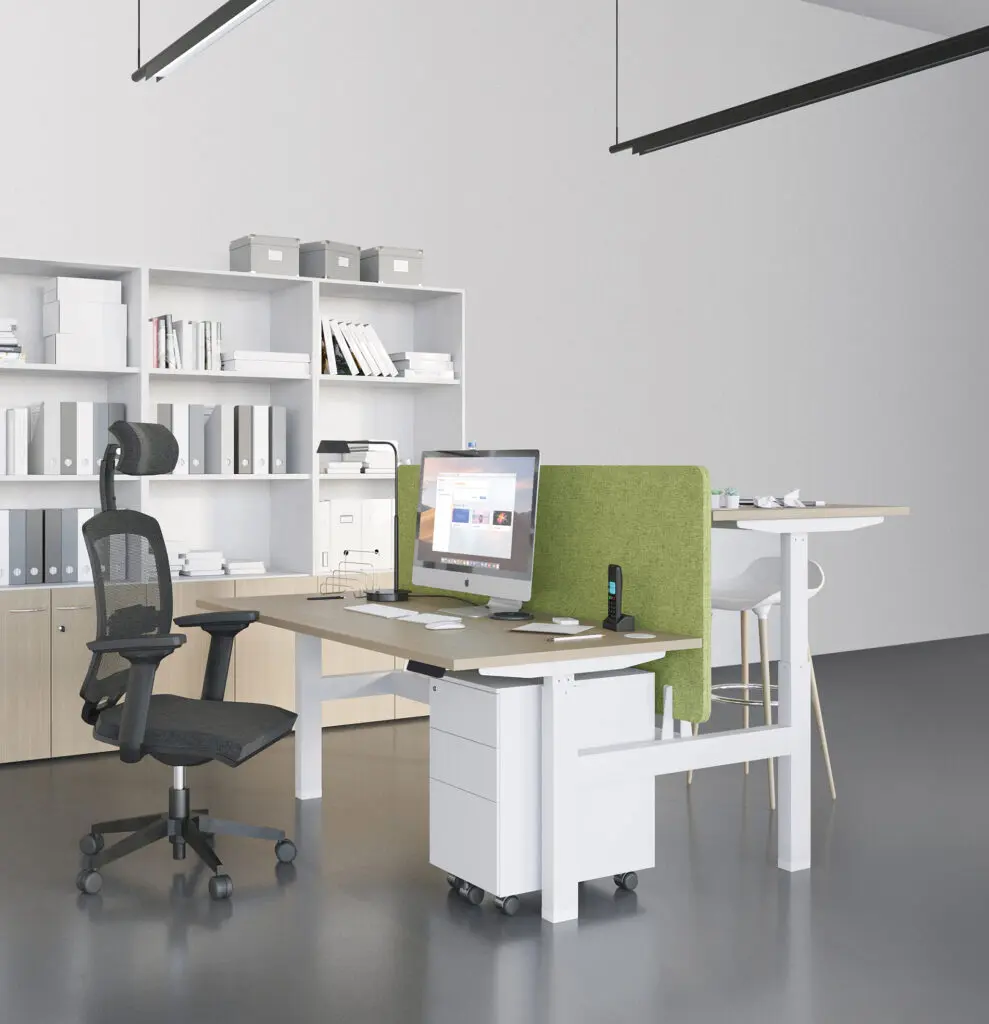
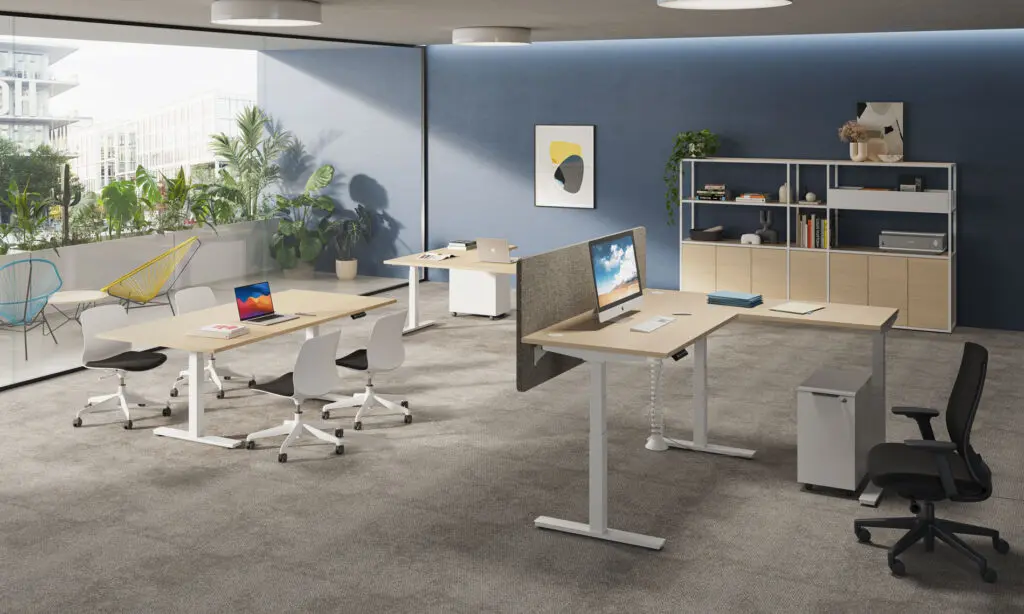
The Envol Evo electric sit-stand desks offer an adjustment range of 63 to 128 cm, quiet motorized adjustment, and position memory. They come with a 5-year warranty and are available in a 120 cm width for compact setups.
Tip 4: Use a mobile cabinet rather than a fixed cabinet
A fixed pedestal under the desk occupies a permanent position. A mobile pedestal on casters can be slid under the desk while working and pulled out to access its contents. In a small space, this difference frees up floor space when the pedestal is not in use.
A practical bonus: the mobile unit also serves as a side table or serving cart during a meeting for two.
The Comfort rolling pedestals are available in two configurations: standard or slim, with simple drawers or hanging file drawers. Their dimensions are compatible with the entire Envol range.
Tip 5: Choose folding or wheeled meeting furniture to create a versatile space
In a small office, the meeting room doesn't have a dedicated space. The solution lies elsewhere: meeting furniture that can be put away when not in use.
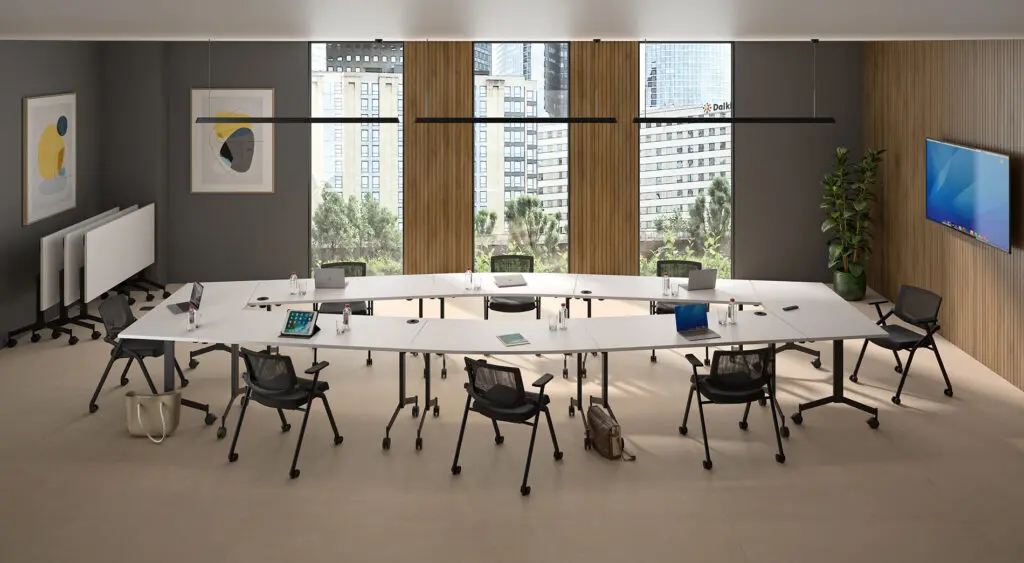
Folding or wheeled meeting tables : pushed against the wall when not in use, unfolded in seconds when needed. Lightweight, stackable chairs: they free up space between sessions. A 20 m² office can become a meeting room for 6 people in 2 minutes with the right furniture.
For office use, the Eureka tables are foldable, on casters, and can be combined. The Libellule chairs are lightweight and stackable. The Partage round table is suitable for small groups, seating up to 4 people.
Tip 6: Define areas without fixed partitions to preserve light
In a small space, fixed partitions take up valuable floor space and block light. Lightweight acoustic dividers or well-positioned storage solutions delineate areas without creating walls.
partitions and can be reconfigured to suit daily needs. partition cabinets can be used as dividers without blocking natural light.
Tip 7: Integrate a privacy solution without dedicating an entire room
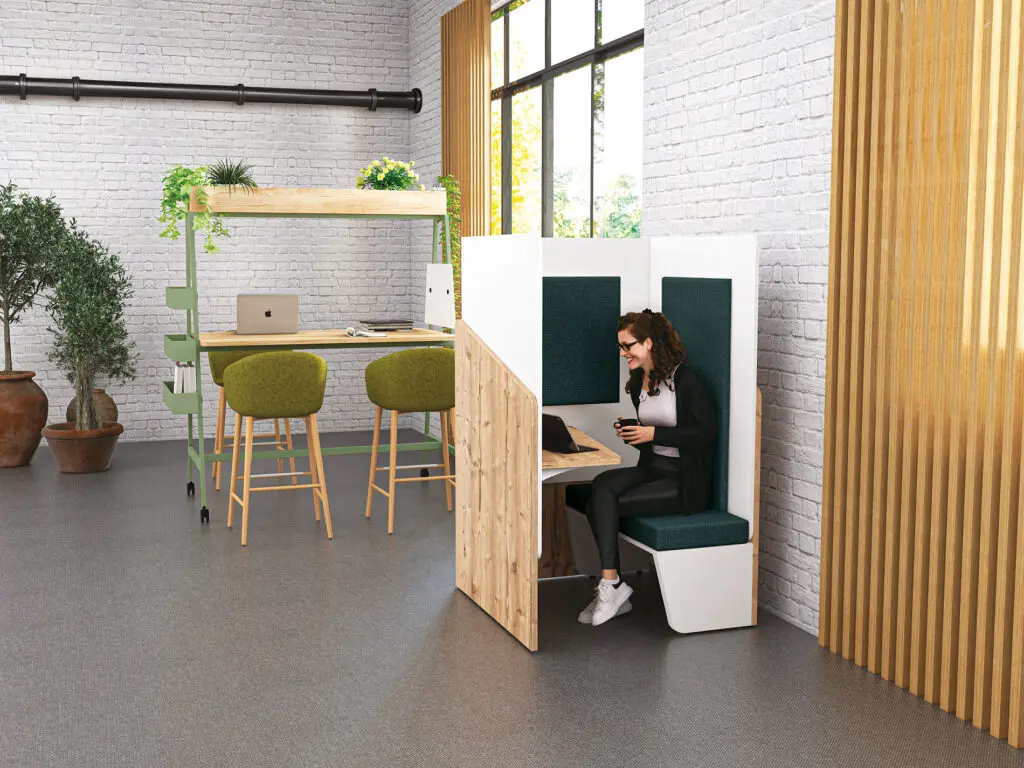
In a small office, confidential calls, interviews, and video conferences become problematic if everyone can hear each other. Acoustic alcoves offer partial soundproofing without taking up an entire room.
A 2 m² alcove can accommodate 80% of the privacy needs of a team of 4 to 6 people.
The acoustic alcoves are semi-open, with high, sound-absorbing backrests. Available in single or double configurations, they fit into spaces of 2 to 4 m².
Which professional office should I choose for a small space?
Choosing a desk is the most impactful decision in a small office space. Here are the types best suited to different layouts.
The compact straight desk: the universal solution
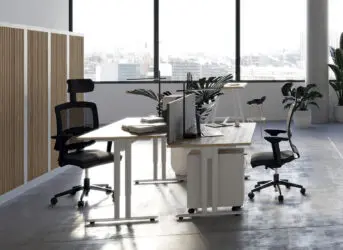
This is the most common and effective solution for small spaces. A width of 120 cm is the minimum for comfortable professional use with a desktop computer. A depth of 80 cm ensures the necessary distance between the eyes and the screen (50 to 70 cm is recommended).
Envol Classic desks are available in several finishes (oak grain, white, Nebraska…), with metal legs. They come with a 5-year warranty.
The desk with a return: two work areas in a corner of the room
This configuration makes use of corner spaces often unused in small offices. It creates two distinct zones without doubling the floor space: a monitor area on one side, and a document or client area on the other. This is subject to checking circulation space around the return.
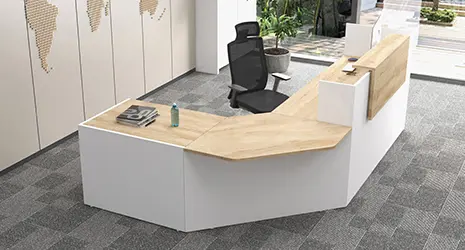
The compact executive office: possible in a small space with the right dimensions
An executive office doesn't necessarily require a large surface area. Starting at 160 x 80 cm, it's possible to create an executive space with a small reception area. The key is to deduct circulation space (80 cm on the sides, 120 cm in front of the desk for a visitor) before choosing the desktop width.
Alto manager desks are suitable for limited spaces. An optional return is available depending on the configuration.
The adjustable electric desk: the best investment in a small individual space
In a small individual office, the only way to change posture without moving is to alternate between sitting and standing. The initial investment is higher than for a fixed desk, but it pays for itself in terms of comfort and health over time.
The Envol Evo desks are the most compact format in the electric range.
Storage solutions to optimize a professional office in a small space
Vertical storage: making the most of wall height
The principle is fundamental. Every square meter of wall space frees up one square meter of floor space.
Tall cabinets at 180 cm are the maximum recommended height to ensure accessibility without a stepladder. Low cabinets at 104 cm serve a triple purpose: separating areas, providing additional work surfaces, and offering storage space.
The Quiétude wardrobes are available in 4 heights (H 72 cm / H 104 cm / H 136 cm / H 201 cm) as well as in several widths.
The mobile storage unit: space-saving storage
Tucked under the desk while you work, it takes up no extra space. Pulled out for a meeting, it becomes a side table or secondary work surface. An integrated lock secures confidential documents.
Comfort pedestals are available on casters, with drawers or a hanging file drawer. Dimensions are compatible with all Envol desks.
Hanging storage and wall surfaces
Wall shelves free up counter space. Limit them to one or two to avoid visually cluttering a small space.
Buronomic does not offer a dedicated wall-mounted product. The recommended combination remains the Quiétude floor storage units, for their consistency with the rest of the furniture.
Ergonomics in a small space: what should never be sacrificed
The chair: the first ergonomic investment
In a small space where movement is limited, the chair is even more critical than in an open-plan office. A chair without multiple adjustments in a shared office guarantees back problems.
The essential criteria:
- adjustable seat height,
- adjustable lumbar support,
- Adjustable armrests.
The Coccinelle and Papillon chairs from buronomic offer multiple adjustments. They are designed to work in synergy with the desks in the range.
Lighting: often overlooked, always impactful
Natural light should be prioritized. Position the desk perpendicular to the window. Never facing it, never with your back to it.
In a small, windowless space, opt for an articulated arm desk lamp with a color temperature of 4000 K (neutral light).
A dark tabletop in a dimly lit space exacerbates eye strain. Choose light finishes for small, dimly lit areas. For office-style work, White or Oak grain finishes are recommended for small, dark spaces.
Cable management: essential in a confined space
In a small office, trailing cables reduce usable space and create hazards. Always check for cable management features or a cable tray in the desk before purchasing. Envol desks have integrated cable management built into the desktop or base.
Typical configurations depending on the available surface area
| Surface | Positions | Recommended configuration | Buronomic products |
| 6 to 9 m² | 1 individual workstation | Desk 120 x 80 cm + Quiétude wardrobe 180 cm + Comfort pedestal | Envol Classic or Envol Evo 120 cm + Quietude + Comfort |
| 10 to 15 m² | 1 workstation + meeting for 4 people. | 120cm desk + Eureka folding table + Dragonfly chairs + storage | Classic Flight or Evo Flight + Eureka + Dragonfly + Quietude |
| 15 to 20 m² | 2 positions | Nuanza 2-station bench or 2 Envol Evo + Comfort cabinets | Nuanza 2-seater or Envol Evo + Comfort |
| 20 to 30 m² | 3 to 4 positions | Nuanza 4-station bench + Calm alcove + Tranquility cabinets + Bewall | Nuanza 4 stations + Calm + Tranquility + Bewall |
Setting up a private office between 6 and 9 m²
The absolute priority is traffic flow: minimum 80 cm behind the seat.
Place a 120 x 80 cm straight desk against one wall, and a tall Quiétude cabinet in the opposite corner. The Comfort pedestal sliding under the desk takes up no extra space. If a client reception area is planned, a desk with a return or a mobile side table will suffice.
Recommended configuration: Envol Classic or Envol Evo 120 cm, Quiétude 201 cm wardrobe, Comfort storage unit, Coccinelle or Papillon armchair.
Setting up an office for 2 to 4 workstations in a space between 15 and 30 m²
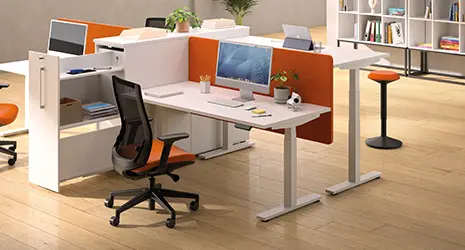
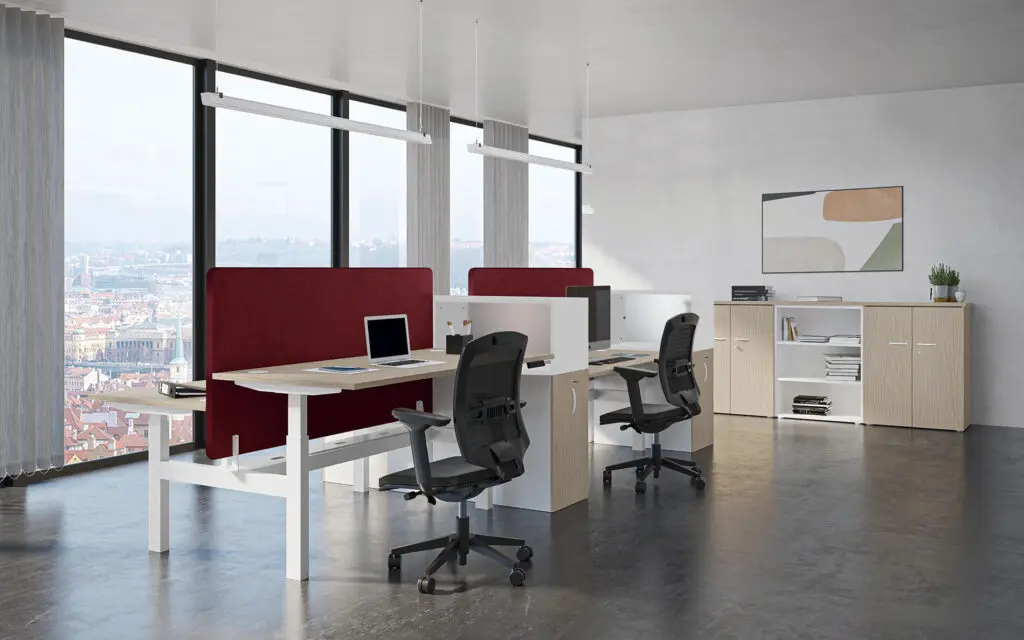
The Nuanza bench is the most compact solution. 120 cm per workstation, 80 cm deep, with integrated acoustic dividers. An alternative: 1 or 2 Envol Evo benches. Two workstations share the same central base, resulting in a 20% space saving.
Provide a folding meeting table on casters to adapt the space as needed. A quiet alcove on the periphery absorbs calls and provides a quiet space for focused work.
Recommended configuration: Nuanza bench (2 to 6 stations depending on the width) or Envol Evo desks, Eureka folding table, Libellule chairs, Calme alcove, Quiétude cabinets, Comfort pedestals.
The most common mistakes in a small professional office
Choosing a desk that's too big
A 180 cm wide desk in a 12 m² space leaves less than 60 cm of room to move around. This is both impractical and uncomfortable. The rule is: factor in movement space before choosing the desk width, not after.
Multiply the low storage units instead of mounting them
Low cabinets (60 cm high) take up as much space as a tall cabinet (180 cm) but store three times less. Always opt for vertical storage in a small space.
Forgetting to provide a minimal meeting space
Even a private office occasionally receives a visitor or holds a meeting for two. The solution for those without much space: a folding Eureka table and two stackable Dragonfly chairs, stored against the wall when not in use.
Choosing furniture that is too visually heavy
In a small space, dark, bulky furniture with thick lines visually overwhelms the room. Opt instead for light finishes, slender metal legs, and clean lines. For a more office-like feel, white or oak grain finishes are recommended for small spaces.
Neglecting acoustics in a shared office with two or three workstations
In a 15-20 m² office with 2-4 employees, every phone call can be heard from everywhere. The solution without construction work: acoustic dividers on Nuanza bench desks, complemented by a quiet call alcove.
A small, well-designed workspace is more efficient than a large, poorly organized one. This is a fact that projects confirm every year.
Three golden rules structure the approach. Measure before you buy. Use vertical space for storage. Choose modular and reconfigurable furniture.
The 7 tips can ultimately be summarized quite easily.
A desk of the right dimensions.
Vertical storage.
An electric desk for ergonomics with a constant surface area.
A mobile pedestal for flexibility.
Folding tables for versatility.
Dividers without fixed partitions to preserve light.
A privacy alcove for specific uses.