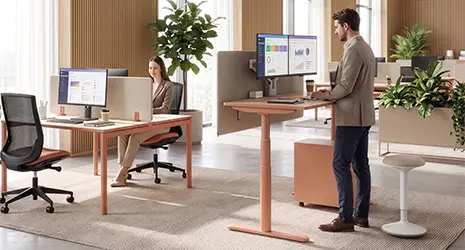
This scenario should probably sound familiar: a colleague on a video conference from their open workstation. Two colleagues debriefing a few meters away. A third trying to concentrate on an urgent report.
The result? Nobody works in good conditions. This scene is repeated every day in far too many open-plan offices in France.
While open-plan offices have been widely adopted for their many advantages – collaboration, flexibility, and space efficiency – their main drawback remains: noise. And it's still not solved.
The figures speak for themselves. More than half of French employees say they are bothered by noise at work. And when you consider that 80% of the workforce operates in open-plan offices, the problem remains significant. Productivity loss reaches 30 minutes of work per day according to the JNA (National Noise Awareness Day), and up to 86 minutes according to an Ipsos study. An invisible but very real cost. While the NF S 31-080 standard sets a target level between 40 and 55 dB depending on the activity, in an untreated open-plan office, noise levels regularly reach 60 to 65 dB.
Two strategies allow us to take action.
- Absorption that reduces reverberation.
- The separation that blocks propagation.
All Buronomic solutions rely on one or both of these principles. No structural work is required, and no premises are taken out of service. The Buronomic perspective is clear: acoustics is not an architect's or construction site's responsibility. It's a furniture matter. And that's precisely what Buronomic has been designing and manufacturing in France for over 45 years.
This article presents seven concrete solutions. Each is embodied by a product designed by us. For each acoustic solution, you will find the problem solved, how it works, its level of effectiveness, its suitable uses, the mistake to avoid, and the recommended deployment ratio.
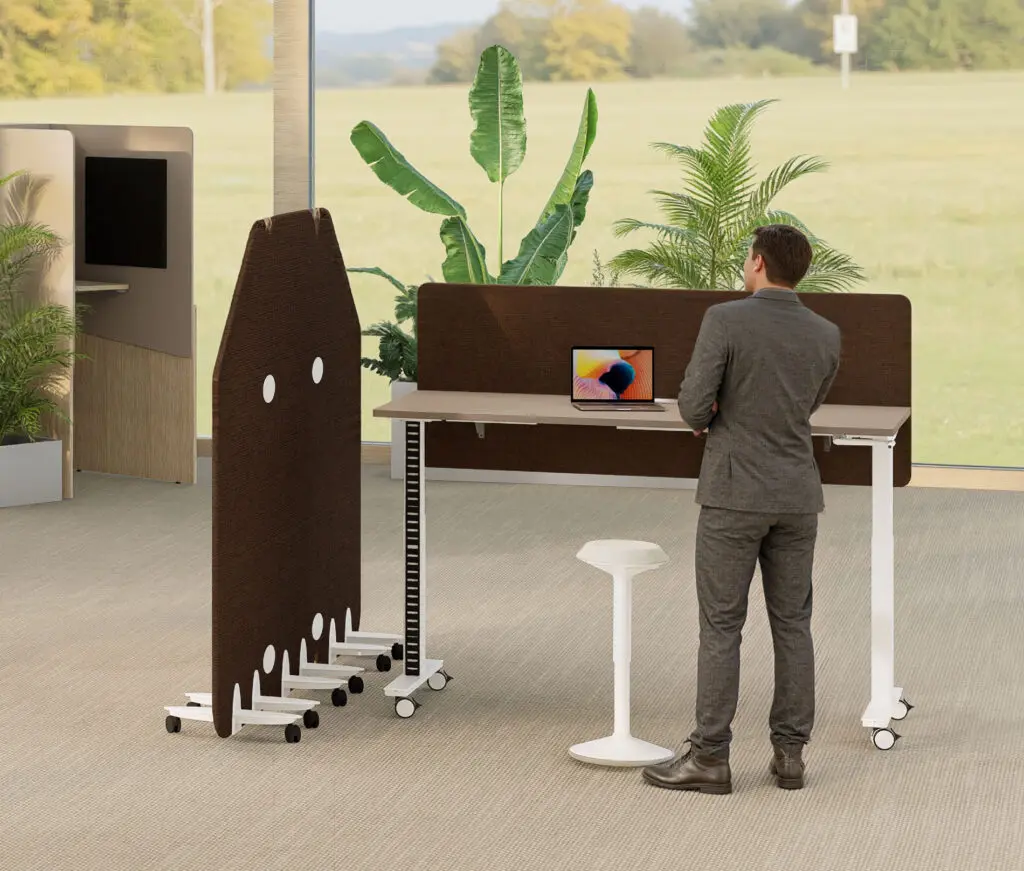
Solution 1: Bewall partitions to delineate islands and absorb sound at the source
The sound problem has been solved:
Sound travels freely from one island to another without any physical obstacle to slow it down or absorb it. Telephone conversations and team exchanges spread throughout the entire set.
How it works:
Bewall partitions combine two strategies: separation and absorption. The sound-absorbing materials integrated into the panels capture sound waves instead of reflecting them. They reduce both the horizontal propagation of sound and reverberation in the area.
Level of effectiveness:
The reduction in perceived noise levels in adjacent areas is measurable. The higher the partition, the more effective the treatment. A partition at 136 cm treats sounds at stage level. A partition at 180 cm also treats standing conversations.
Before/after:
Before: every phone conversation can be heard throughout the entire studio.
After: the work areas are acoustically separated. Ambient noise decreases without anyone changing their behavior.
Suitable uses:
- Delineation of work areas in open space.
- Separation of a noisy area (telephone, informal meeting) and a concentration area.
- Creation of temporary quiet zones for specific projects.
Common mistake:
Installing partitions that are too low (60 cm) will only absorb sound at stage level, letting through everything above, especially voices.
Another pitfall is placing partitions in the direction of communication flow rather than perpendicular to it.
Buronomic products:
Bewall acoustic partitions are available in heights of 136, 160, and 180 cm. They feature a modular structure with fabric stretched over a frame, requiring no wall mounting. Configurations include straight, L-shaped, and U-shaped layouts to suit the island's shape. They are compatible with Envol desks and Nuanza benches. Installation is complete upon delivery, requiring no tools or construction work.
Practical deployment rule:
Recommended ratio: 1 partition for 4 workstations in a standard open-plan office. In a dense open-plan office or one with high telephone activity: 1 partition for 2 to 3 workstations.
Solution 2: Desktop partition screens to isolate each workstation individually
The sound problem has been solved:
Conversations and keyboard noises from neighboring workstations disturb every employee without any barriers between them. On a multi-user bench, the neighbor to the left and the neighbor to the right share the same sound space.
How it works:
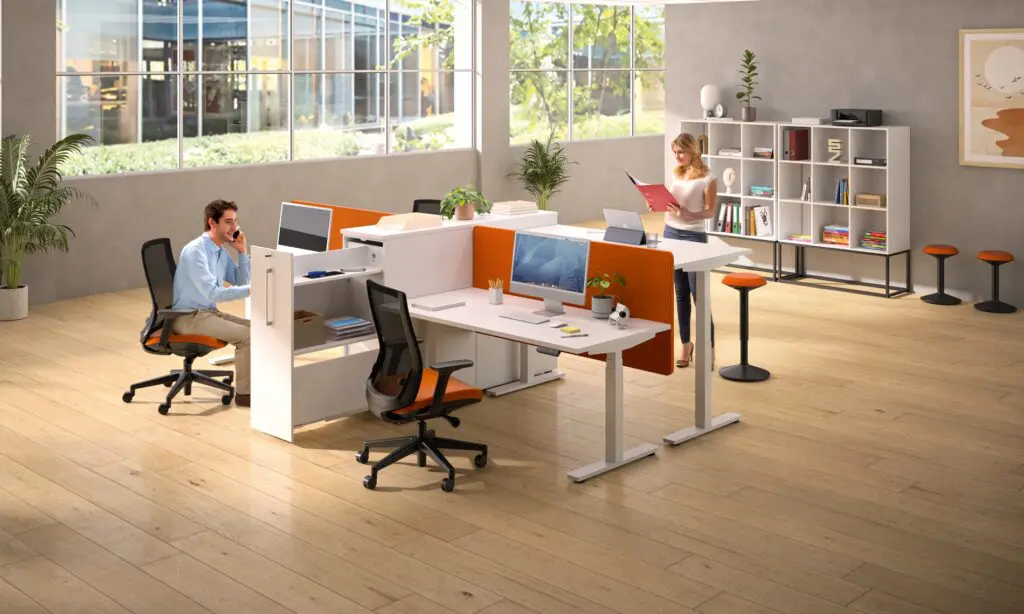
The screen works by absorbing sound at its source, at the level of the work surface. It captures sounds as close as possible to their origin, before they propagate. The effect is combined: a reduction in noise perceived by those nearby, and a slight reduction in noise reaching the user themselves.
Before/after:
Before: On a 6-station bench, each user could hear the other 5. After: Each screen creates an individual work bubble that reduces direct left-to-right interference.
Suitable uses:
- Multi-station bench in open space.
- Adjacent positions with high telephone or verbal activity.
- Flex office where workstations change hands every day.
Common mistake:
Choosing screens based solely on aesthetics, without checking their absorption coefficient, is another mistake. Choosing screens that are too low (less than 30 cm) creates no real acoustic barrier.
Buronomic products:
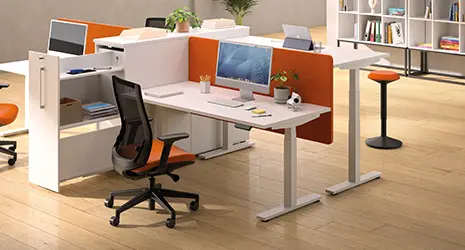
Acoustic dividers are available for Envol Classic, Envol One, Envol Evo desks and Nuanza benches. Height from the desktop: 40 cm. Several fabric colors coordinate with the office collections. Direct attachment to the desktop; no complex installation required.
Practical deployment rule:
Recommended ratio: 1 screen per workstation in a bench configuration, prioritizing workstations with high verbal activity. Combine with Bewall partitions for a two-level approach: workstation and island.
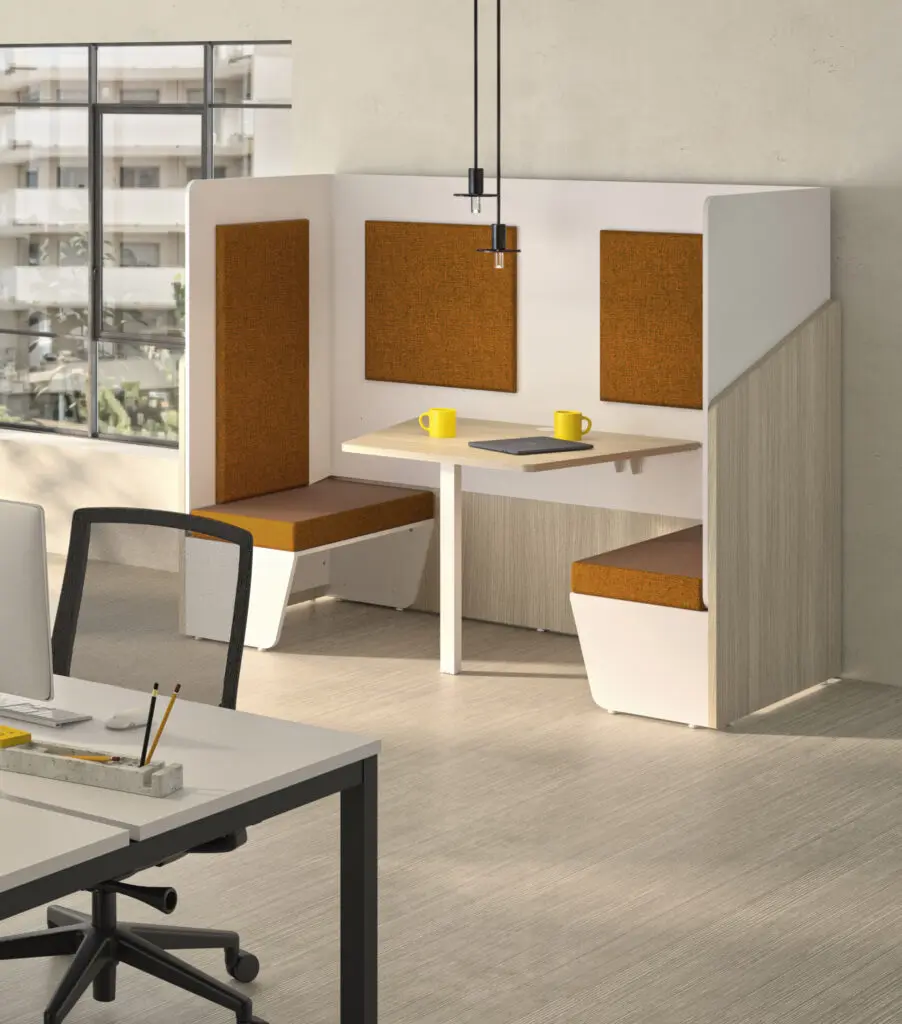
Solution 3: Alto privacy alcoves for seclusion without leaving the open-plan office
The sound problem has been solved:
Employees who need to concentrate or have privacy have nowhere to go without leaving the open-plan office and booking a private room. Short calls and sensitive conversations take place from the open workstation, disturbing those nearby and lacking privacy.
How it works:
The alcove works by enveloping absorption. The high backrests made of absorbent fabric create an acoustic cocoon. They reduce incoming sounds and partially contain outgoing sounds. Not total isolation, but a significant reduction in interference in both directions.
Level of effectiveness:
Intermediate level. The alcove is ideal for short calls (less than 10 minutes), focused work (30 to 60 minutes), and confidential conversations at a moderate volume. A key selling point: an Alto alcove replaces a 2-person meeting room for 80% of daily uses, without the need for a reservation.
Before/after:
Before: phone calls were made from the open phone line, disturbing the neighbors and lacking privacy. After: the alcove offers an immediately available space, without negative signals or a feeling of confinement.
Suitable uses:
- Short phone calls.
- Individual concentration exercise lasting 30 to 60 minutes.
- Informal one-on-one interviews.
- Reading, writing, tasks requiring high attention.
[product photo Alto privacy alcove]
Common mistake:
Don't expect total soundproofing comparable to a closed booth. The alcove is a semi-open bubble, not a soundproof booth [link to the acoustic booth category]. Another mistake: placing the alcove in a high-traffic area, where the ambient noise is too high for the cocoon to be effective.
Buronomic products:
The Alto privacy alcoves are available in single and double seat versions. They feature a wraparound backrest in absorbent fabric and a high-density padded seat. Several fabric colors are available, coordinating with the Alto collection.
Practical deployment rule: Recommended ratio: 1 alcove for every 6 workstations in a mixed-use open-plan office. To be placed on the periphery of the floor, away from high-traffic areas.
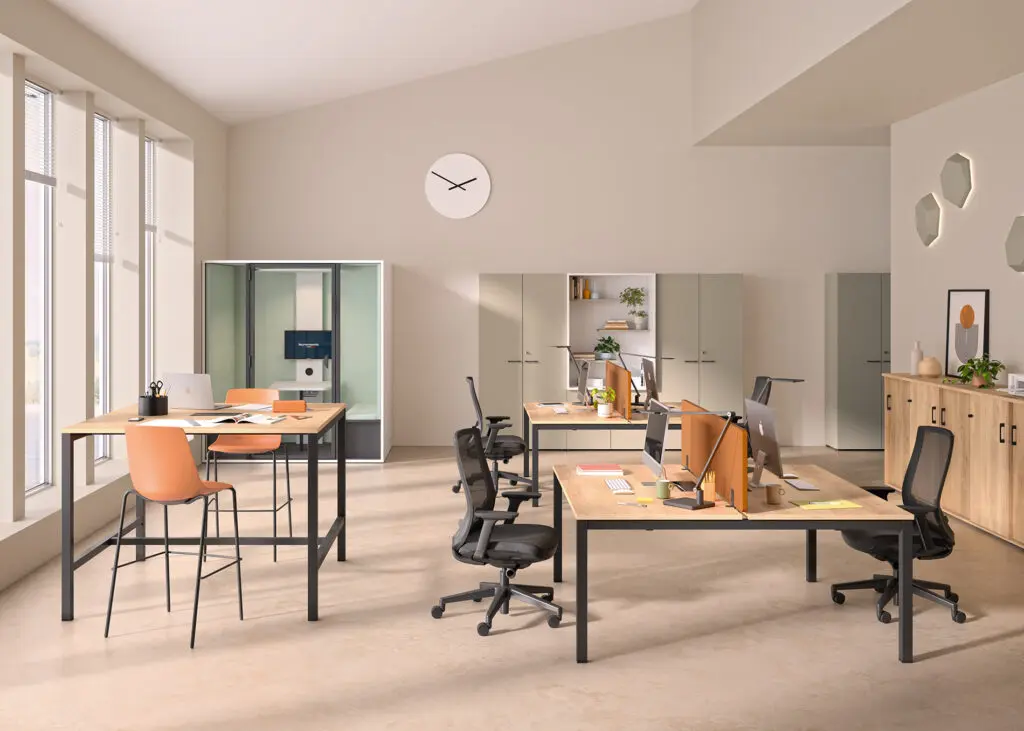
Solution 4: The Essential acoustic booth for complete and immediate sound insulation
The sound problem has been solved:
Long calls, video conferences, HR interviews, and confidential meetings cannot be held in an open-plan office without causing disruption. Without dedicated booths, employees use meeting rooms for one or two people, thus overcrowding spaces designed for eight to twelve participants.
How it works:
The Essential booth provides complete two-way soundproofing. The insulating walls block sound transmission in both directions. Noise from the open-plan office doesn't enter the booth, and conversations from the booth don't spill out into the open-plan office. The interior sound-absorbing materials eliminate reverberation for optimal listening comfort.
Level of effectiveness:
The reduction is approximately 30.3 dB compared to the noise level of the surrounding open-plan office. This is equivalent to a closed room, without the cost or architectural constraints. Acoustic certification is measurable; please check the product catalog.
Before/after:
Before: Video conferences from the workstation disrupted the entire floor and were themselves disrupted by ambient noise.
After: The Essential booth offers a soundproof space, immediately available, without reservation.
Suitable uses:
- Video conferences and online meetings.
- Long phone calls.
- Confidential HR, managerial or commercial interviews.
- Deep work requiring maximum and prolonged concentration.
- Meetings for 2 or 3 people without needing a large room.
Common mistake:
Undersizing the number of booths relative to actual usage is a mistake. A single booth for a floor with 20 workstations and high call volume immediately creates queues and widespread frustration.
Another error is neglecting interior ventilation. An unventilated booth becomes uncomfortable after just a few minutes.
Buronomic products:
The acoustic booth is available in 1-person, 2-person, 4-person, and 6-person versions. Its glass walls maintain brightness and visibility in the open space, without a "black box" effect.
Integrated equipment: seat, tablet, electrical outlets, ventilation. Installation without floor anchoring or construction work. The booth can be moved to accommodate floor layout changes. Setup is estimated to take a few hours and can be carried out by the Buronomic team or a partner distributor.
[Product photo: Essential Acoustic Booth]
Solution 5: Alto sofas and armchairs to transform relaxation areas into absorbent spaces
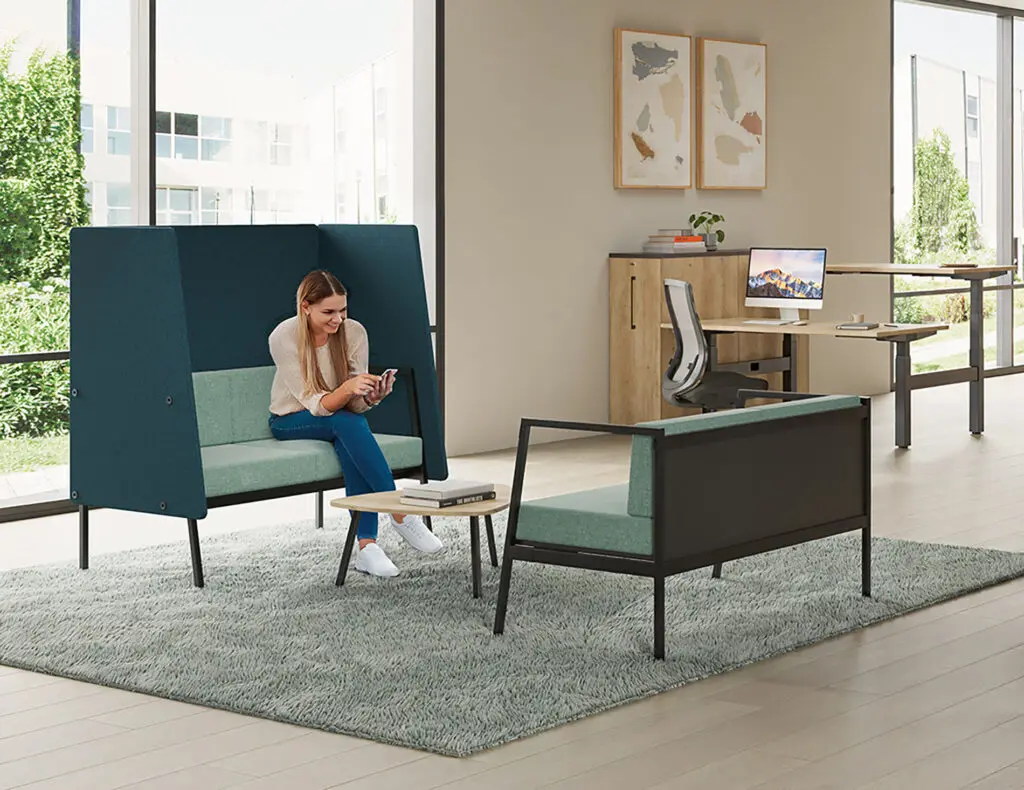
The sound problem has been solved:
Relaxation and informal meeting areas are often the noisiest parts of an open-plan office. Furnished with hardwood, metal, or plastic, they reflect sound and increase the overall noise level instead of absorbing it.
How it works:
The absorption is passive, integrated into the furniture. The upholstered fabric naturally absorbs sound waves. It reduces reverberation in the area and limits the propagation to neighboring workstations. The larger the fabric surface area and the denser the padding, the more effective the absorption.
Level of effectiveness:
The absorption is passive, not measured in dB but perceived immediately. A lounge area of 8 to 10 m² fully furnished with upholstered fabric (3-seater sofa, 2 armchairs, coffee table) constitutes significant passive acoustic treatment for the area.
Before/after:
Before: The coffee corner, with its plastic chairs and wooden table, amplified every conversation and reflected noise towards neighboring workstations.
After: The Alto sofas and armchairs absorb sounds from the area. The perceived noise level decreases for both users and neighbors.
[product photo Alto sofas and armchairs]
Suitable uses:
- Relaxation and rest areas.
- Informal meeting spaces.
- Coffee corners and reception areas.
- Open-plan social spaces.
Common mistake:
Furnishing relaxation areas with hard furniture (bare wood, metal, plastic) for ease of maintenance actually increases the noise level throughout the entire area.
Another pitfall is choosing non-professional fabrics that won't withstand heavy use in a business setting.
Buronomic products:
The Alto collection includes 2-seater and 3-seater sofas, armchairs, and side tables. Professional-grade fabric upholstery is available in a wide range of colors and is resistant to heavy use. Recommended configuration: a 3-seater sofa, two armchairs, and an Alto coffee table create a complete sound-absorbing area of 8 to 10 m². The Alto collection coordinates with the Alto alcoves for a cohesive look.
Solution 6: Quiet spaces for acoustically controlled informal meetings
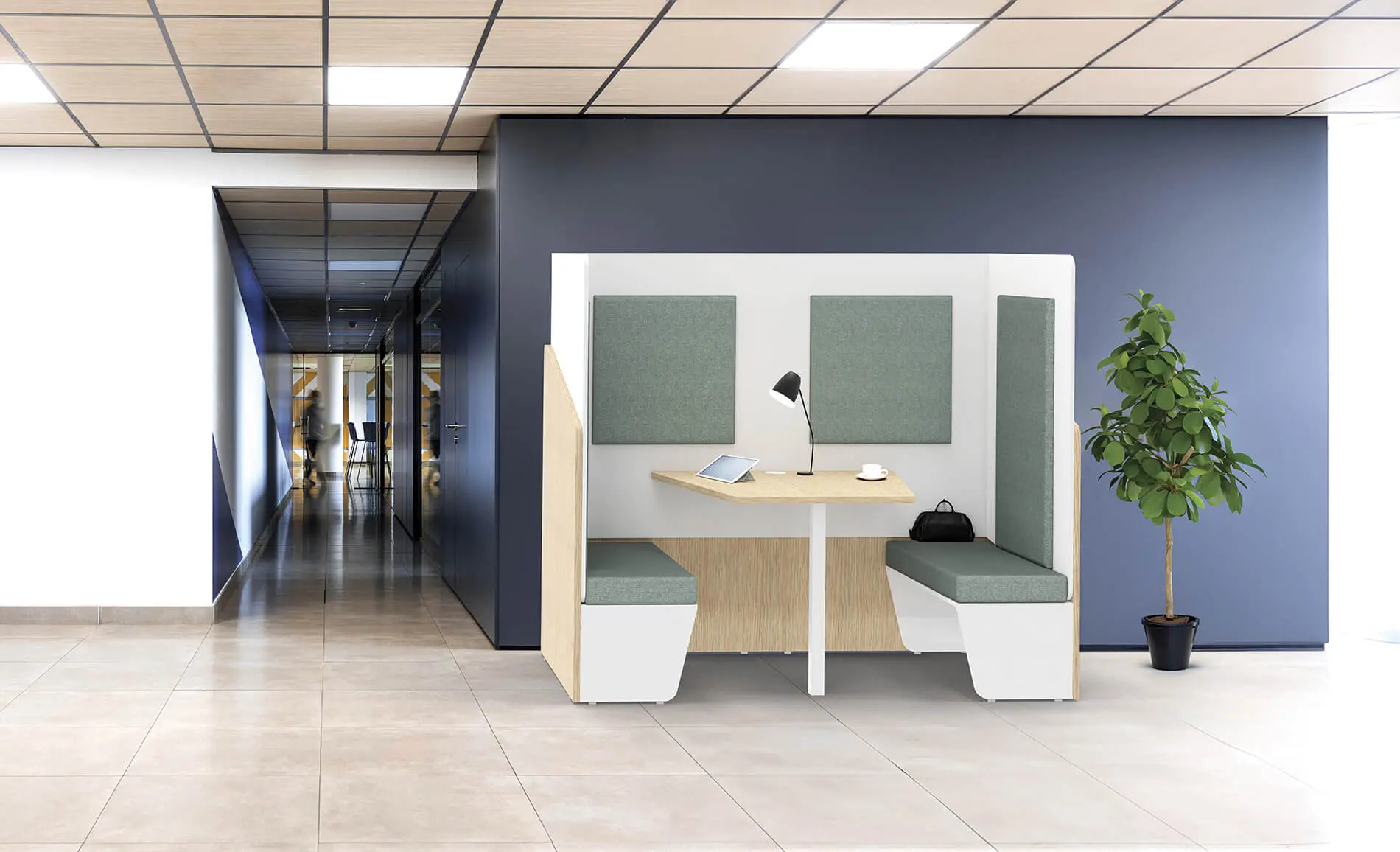
The sound problem has been solved:
Informal standing meetings in the open-plan office generate noise for neighbors and lack privacy for participants. Spontaneous conversations of two to four people take place haphazardly, anywhere on the floor, without any acoustically designed designated areas.
How it works:
The effect relies on highly efficient, enveloping sound absorption. The high, enveloping backrests made of absorbent fabric create an acoustic cocoon. They capture sounds within the space and reduce their propagation outwards. The semi-enclosed configuration directs conversations inwards, limiting sound diffusion on the stage.
Level of effectiveness:
Intermediate to high level of comfort depending on the configuration. Comparable to an alcove, but designed for 1 to 2 people and for standing or semi-seated conversations. Key selling point: it's a direct alternative to meeting rooms for short exchanges, without reservation and without leaving the floor.
Before/after:
Before: Team briefings were held between desks, disturbing everyone around. After: The Calm space offers a natural setting that contains discussions and reduces their noise impact on the floor.
Suitable uses:
- Short briefings and team points (less than 20 minutes).
- Spontaneous exchanges between 2 people.
- Quick debriefings after the meeting.
- Areas for creativity and informal brainstorming.
Common mistake:
Placing the Quiet alcoves in the center of the floor plan, where their residual noise spreads in all directions. Another mistake: under-provisioning the number of Team Building spaces, which forces teams to hold their discussions from their workstations.
Buronomic products:
The Calme alcove spaces are available in low and high versions. Upholstered in absorbent fabric, they come in several colors and feature padded seats. They can be combined with Quiétude storage units as side dividers to enhance the cozy atmosphere. The entire collection coordinates with the Alto collection for a cohesive look.
Solution 7: Quiétude storage units as structural acoustic dividers
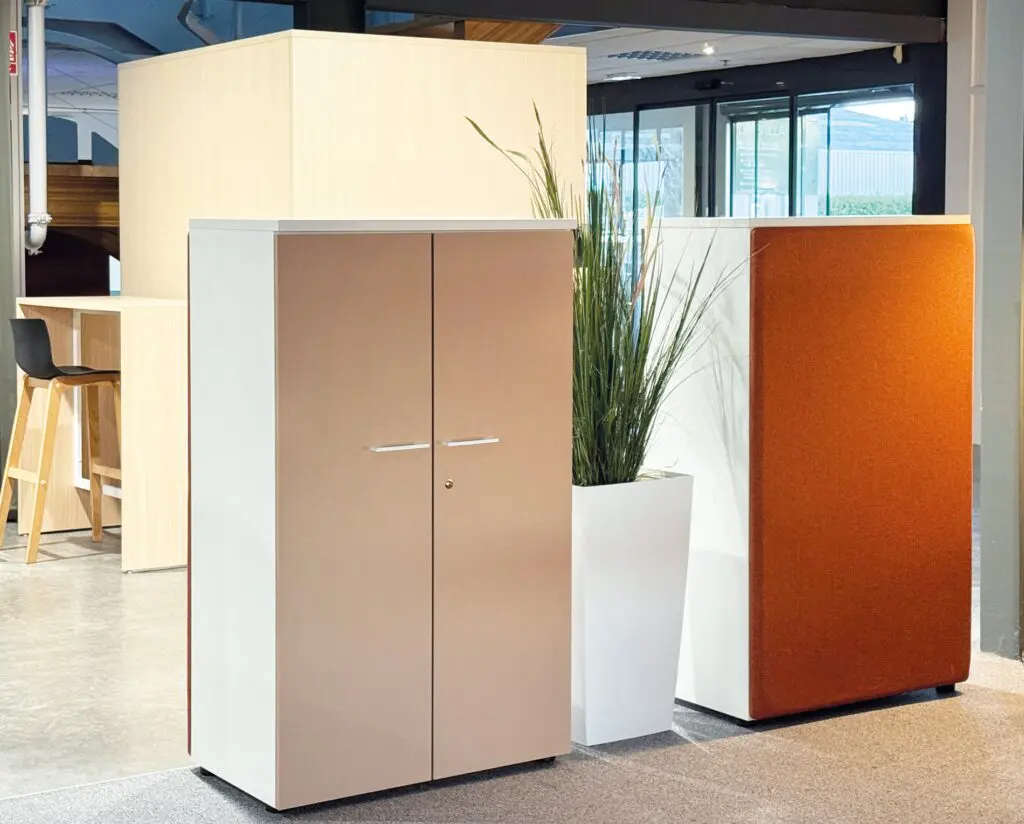
The sound problem has been solved:
Standard storage units made of metal or hardwood reflect sound and worsen reverberation in open-plan offices. Partitions between zones are often non-existent, or made with non-absorbent furniture that does not solve the acoustic problem.
How it works:
Quiétude cabinets combine absorption and separation. The optional fabric sound-absorbing panels capture sound waves instead of reflecting them. As room dividers, they create a physical barrier that reduces the direct propagation of sound between two areas. They offer dual functionality: storage and acoustics (absorption and separation).
Level of effectiveness:
The level of effectiveness depends on the height. 104 cm: acoustic treatment at countertop level. 136 cm: effective separation at intermediate height. 160 cm: complete separation. Positioned perpendicular to the islands, their acoustic effectiveness is maximized.
Before/after:
Before: Metal cabinets reflected sound and created echo zones between rows of desks.
After: Quiétude cabinets absorbed sound instead of reflecting it. They acoustically separate areas without completely blocking the view.
Suitable uses:
- Separation between relaxation area and work area.
- Delineation of work islands without fixed partitions.
- Absorbent, close-proximity storage between two facing workstations.
- Support for Alto alcoves and Cohesion spaces as lateral dividers.
Common mistake:
Using Quiétude cabinets solely for their storage function, without positioning them to maximize their acoustic barrier effect, is another mistake. Choosing the height based solely on aesthetics, without considering the impact on the acoustics of the area, is another error.
Buronomic products:
The Quiétude storage units are available in heights of 72, 104, 136, and 201 cm. An integrated seat option is available on the B-box consoles, offering double the storage value and a comfortable seat for transitions. Several widths are available, as detailed in the catalog. They are compatible with Alto alcoves, Cohésion spaces, and Bewall partitions for consistent acoustic treatment. Aesthetically coordinated with all Buronomic collections.
Frequently asked questions about acoustic solutions in open-plan offices
What is the quickest acoustic solution to implement?
Desktop partition screens. They deploy instantly, workstation by workstation, without any space reconfiguration or installation delays. In second place: Bewall partitions, which can be installed upon delivery without tools or anchors.
What is the difference between an acoustic alcove and an acoustic booth?
| Criteria | Alcove Alto | Essential Cabin |
| Insulation | Partial, intermediate | Total, up to -30.3 dB |
| Ability | 1 to 6 people | 1 to 6 people |
| Feeling | Open, no confinement | Closed, completely isolated |
| Use | Short calls, focused attention | Video conferencing, interviews, deep work |
| Facility | Standard furniture | Freestanding, several hours |
Should we combine several solutions or is one enough?
A single solution only addresses one source of the problem. The minimum recommended approach is to combine two complementary solutions: one for sound absorption (upholstered furniture, Quiétude storage units) and one for separation (Bewall partitions, alcoves). For measurable results across an entire floor, plan for at least three combined solutions.
Is it possible to treat the acoustics of an open-plan office without carrying out any construction work?
Yes. That's the buronomic approach. The seven solutions presented require no construction work, are reversible, and immediately operational. They are also movable and reconfigurable as the workspace evolves.
What is the difference between sound insulation and soundproofing?
Insulation prevents sound from passing through a wall. This is the role of freestanding booths. Acoustic correction reduces reverberation within a space. This is achieved with fabric furniture and sound-absorbing panels. In an open-plan office without construction work, the effective approach combines both: correction via furniture, and partial insulation via booths.
How many acoustic booths should be planned for an open-plan office with 20 workstations?
For mixed use (meetings, calls, focused work), 2 Essential booths are the minimum. For use with a high volume of phone calls, plan for 2 to 3 booths supplemented by alcoves. The general rule of thumb is 1 booth for every 8 to 10 workstations as a starting point.
Are Buronomic acoustic solutions compatible with each other?
Yes. All the solutions are designed to work together. The Alto collection (sofas, armchairs, alcoves) is aesthetically coordinated. The Quiétude cabinets combine with the Bewall and Alto alcoves for a cohesive look. The buronomic project service supports the design of a comprehensive acoustic plan.
Seven solutions, seven concrete levers for action.
Bewall partitions delineate workstations and absorb sound at the source. Separation screens isolate each workstation individually. Alto alcoves offer an open retreat for short calls and focused work. The Essential booth provides complete soundproofing for video conferencing and interviews. Alto sofas and armchairs transform relaxation areas into sound-absorbing spaces. Calm alcoves are ideal for informal meetings. Quietude storage units structure the open-plan area with acoustic dividers.
The key principle remains the same: combine at least one absorption solution and one separation solution to obtain a measurable result. Acoustics in open-plan offices is no longer a matter of construction work. It's a matter of furniture, accessible immediately, without a special budget, and without taking the premises out of service.