We spend an average of 16 years of our professional lives in meetings. Yet, the meeting room often remains the least well-designed space in the office: unsuitable furniture, neglected acoustics, outdated equipment. Meetings drag on. Participants lose focus. Company productivity suffers.
Properly equipping a meeting room rests on three pillars.
- Furniture adapted to the type of meeting.
- Reliable technological equipment.
- An acoustic environment conducive to exchange and concentration.
These three dimensions are inseparable and must be considered together from the very beginning of the project. In this article, buronomic guides you step by step to make the right choices foryour meeting room layout. From furniture to the details that make all the difference, every aspect is reviewed to help you create a meeting room that meets your requirements.
What are your needs?
What surface area should be planned depending on the number of participants?
The rule for personal space is simple. Allow at least 1 m² per seated person. Then add circulation space: 90 cm at the end of the table, 120 cm on the sides.
Here is a quick guide based on the desired capacity:
| Number of participants | Recommended surface |
| 4 people | 10 to 12 m² |
| 6 people | 15 m² |
| 10 people | 20 to 25 m² |
| 15 people or more | 30 m² minimum |
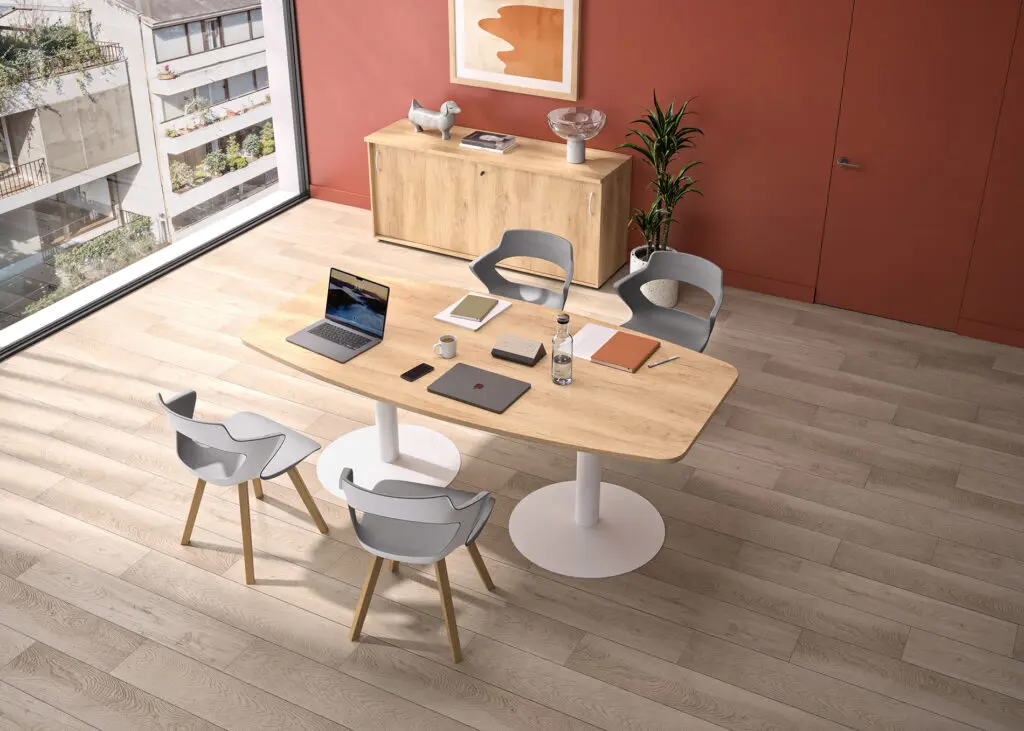
What type of meeting is being held in this space?
Formal meeting, informal exchange, brainstorming session, video conference, client presentation, training session… Each use case requires a different setup. It is therefore necessary to identify in advance the actual uses that will determine the choices of furniture and equipment.
What are the steps involved in equipping a meeting room?
Equipping a meeting room is not something to be done on a whim. Here are six steps to follow in order to avoid mistakes and unnecessary expenses.
Step 1: Assess the available space and the number of participants
Before choosing any furniture, measure the space and determine the maximum number of users. This is the starting point of the project.
Step 2: Choose the furniture configuration and layout
Rectangular, oval, U-shaped, island, or high tables. The layout depends directly on the uses identified in the previous step.
Step 3: Select the appropriate tables and seating
The central furniture must meet the comfort of the participants and the average duration of the meetings that will be held there.
Step 4: Integrate the technological equipment
Connectivity, screen, video conferencing: the furniture must be designed to accommodate these devices without improvisation.
Step 5: Treat the room acoustics
Acoustic panels, partitions, textile coverings. Acoustics influence the quality of discussions and the fatigue experienced by participants.
Step 6: Pay attention to the decoration and visual consistency with the company's identity
The meeting room reflects the company's image. It must fit within the overall coherence of the workspaces.
Focusing on modularity means adapting to all uses
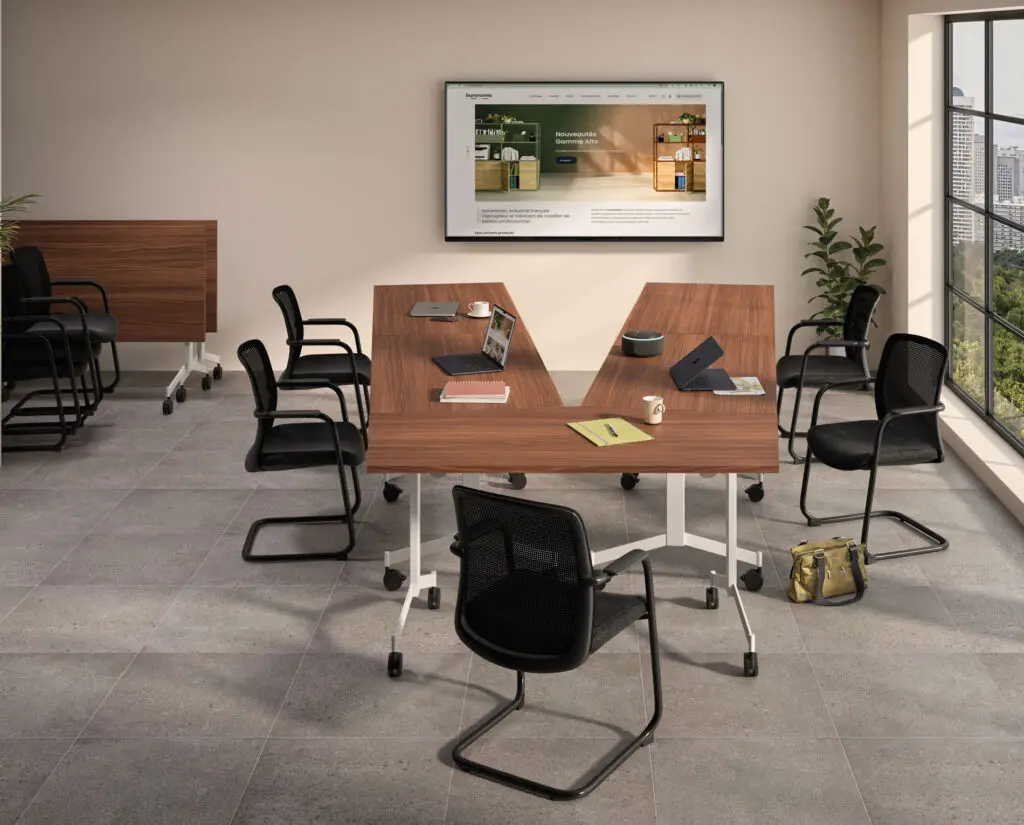
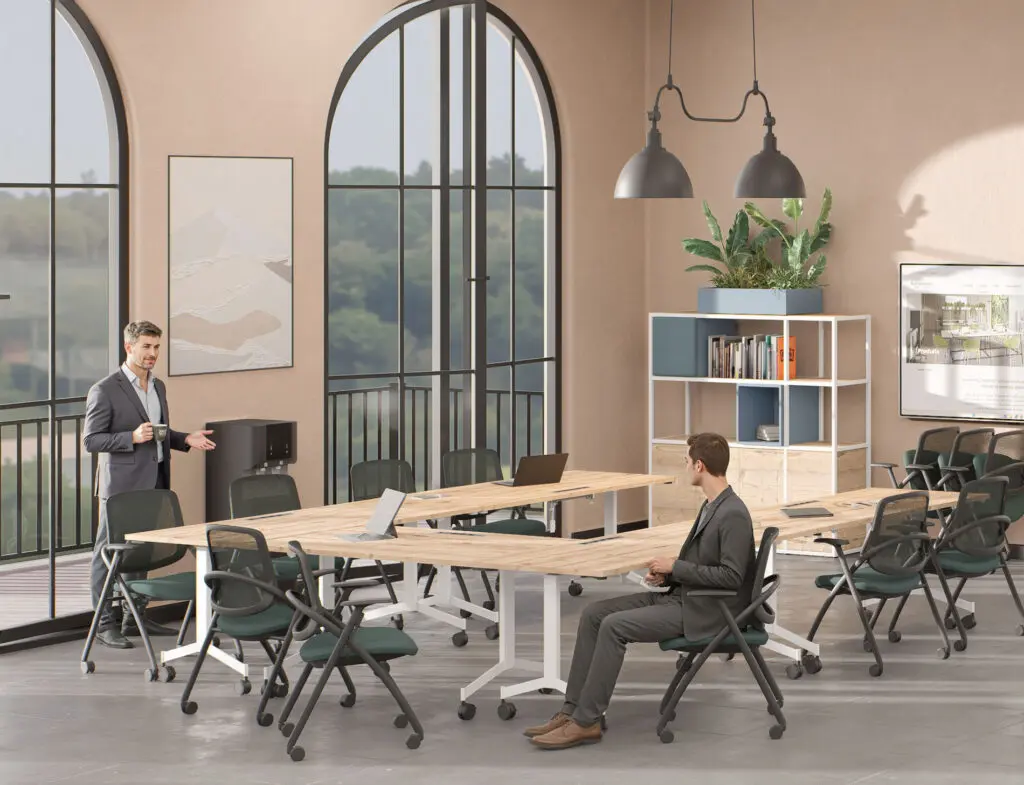
Unlike a room fixed in a single configuration, a modular room can adapt to any meeting format in minutes. This is the approach championed by buronomic. Tables on casters, stackable chairs, and movable partitions transform the same space into a formal meeting room in the morning and a brainstorming area in the afternoon.
Modular meeting tables
Folding tables, tables on casters, modular tables: the criteria for choosing a table that adapts to multiple configurations are just as important as aesthetics. fliptop tables Eureka are designed with this in mind. Modular and on casters, they allow you to quickly reconfigure the space according to your needs.
Stackable chairs and armchairs
Lightweight, stackable, and easy-to-move seating allows you to reconfigure the room in minutes. Elytre folding meeting chairs are lightweight, stackable, and stylish. They are suitable for configurations that change throughout the day. For longer meetings, ergonomic chairs Papillon Color offer enhanced comfort and support adapted to the duration of the session.
Movable partitions to delimit and adapt the space
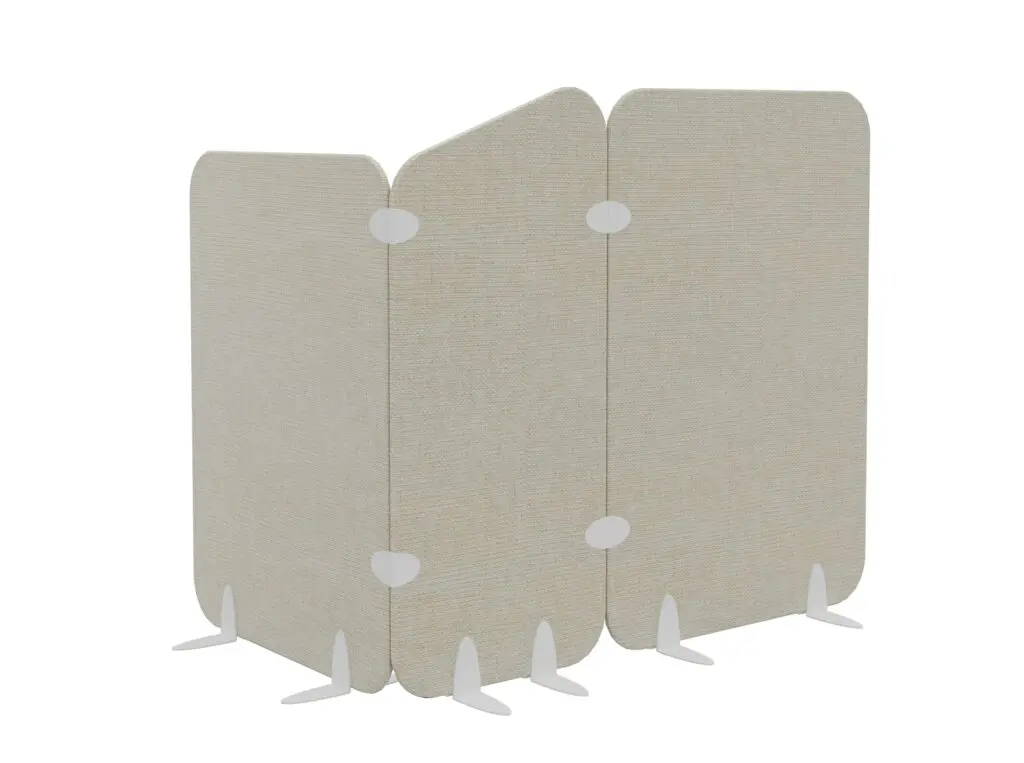
Removable partitions divide a large room into two distinct spaces. They also isolate a work area as needed. partitions Bewall are modular and offer acoustic properties, a major advantage for shared workspaces.
Essential furniture for furnishing a meeting room
Choose the right meeting table according to the desired configuration
The table is the central element of the room. Each configuration calls for a specific model.
For formal meetings, the high table offers a sleek, conference-style design. It is suitable for executive meetings and client presentations.
For modular setups, Eureka tables offer maximum flexibility. For discussions and collaborative work, the round Sharing table promotes equality among participants
The selection criteria to consider:
- the dimensions,
- the shape,
- cable integration,
- and modularity.
Here are the main configurations to consider:
- Rectangular table: formal meetings, up to 20 participants.
- Oval or round table: promotes exchange and equality between participants.
- U-shaped layout: ideal for interactive training and presentations.
- Island setup: brainstorming and group work.
- High tables: stand-up meetings, short and informal meetings.
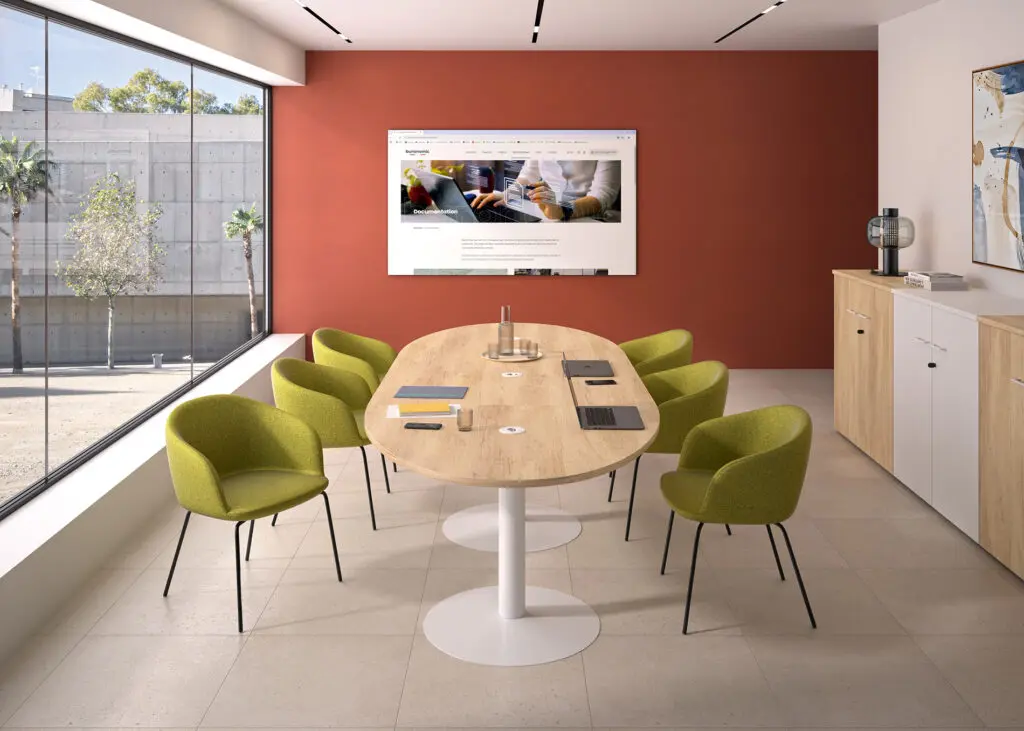
Select seating options appropriate to the duration of the meetings
Comfort, ergonomics, stackability, and mobility: four criteria for choosing the right meeting chairs and armchairs . For long meetings, an ergonomic chair with a supportive backrest is essential. For informal settings, the armchairs in the Alto collection offer comfort and a welcoming atmosphere.
Incorporate high tables for standing meetings
Short, standing meetings are more dynamic and efficient. Nuanza high tables are available on casters. They are suitable for stand-up meetings and informal meeting spaces in open-plan offices.
Plan for storage solutions to keep the room organized
Closed cabinets, mobile pedestals, shelves for technical equipment (cables, remote controls, notepads): storage is an integral part of the meeting room. Buronomic's Quiétude storage solutions combine organization and sound absorption. The Classif range complements this offering for standard filing needs.
The technological equipment of a modern meeting room
Choose furniture that is compatible with your technological equipment
Integrated connectivity in the tabletop, cable management, screen stability: furniture must anticipate technical constraints. Some Buronomic tables integrate connectivity modules directly into the tabletop. Cable clutter disappears, and connections are simplified.
Video conferencing and acoustics: two inseparable issues
A high-performance video conferencing system (camera, microphone, speakers) only reaches its full potential in an acoustically treated room. Without sound absorption, voices resonate, microphones pick up background noise, and remote participants struggle to follow. This is why acoustics should be considered alongside the selection of audiovisual equipment. Dedicated solutions are presented in the following section.
Interactive screen or whiteboard: which to choose?
The whiteboard remains essential for brainstorming. It allows for spontaneous writing, quick sketching, and collaborative work. An interactive digital screen is necessary when the room regularly hosts video conferences or client presentations. The choice therefore depends on the size of the room and the type of meetings held there.
Acoustics: the decisive factor for an effective meeting room
Why acoustics are essential in a meeting room
Poor acoustics lead to listening fatigue, misunderstandings, and unnecessarily long meetings. Rooms with hard surfaces (glass, concrete, hardwood floors) amplify reverberation. Concentration drops, and so does the quality of discussions. The NF EN ISO 3382 standard sets recommended noise levels in workspaces. Adhering to it ensures an environment conducive to collaborative work.
Acoustic solutions that can be integrated without construction work
No major construction work is needed to improve the acoustics of an existing room. Acoustic wall panels, furniture with absorbent coverings, partition walls, thick curtains : these solutions work together.
partitions and Quiétude storage units with fabric backing play a dual role, both functional and acoustic. They integrate seamlessly into the existing structure without requiring structural intervention.
Acoustic booths and alcoves: an alternative to the traditional meeting room
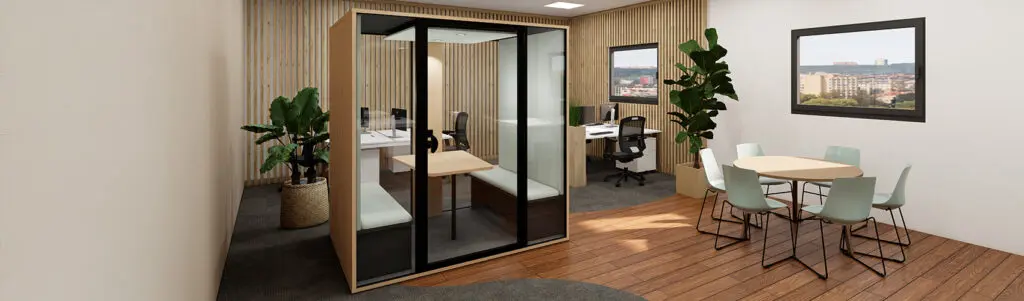
For meetings of two or four people, an entire room is often too large. The privacy alcoves Alto and the Essentielle acoustic booth offer a secluded and intimate space. They integrate seamlessly into open-plan offices. And, most importantly, they require no construction work. A practical solution to everyday privacy needs.
Comparison of meeting room configurations
At buronomic, each meeting setup corresponds to a specific furniture range. Here's a summary to help you make the right choice for your needs.
| Configuration | Recommended use | Number of participants | Recommended table | Recommended seating |
| rectangular table | Formal meeting, presentation | 8 to 20 | Astrolite Table | Elytra Chair |
| Round or oval table | Exchange, co-creation | 4 to 10 | Sharing Table | Alto Armchair |
| U-shaped arrangement | Training, interactive presentation | 6 to 15 | Eureka modular tables | Ladybug Chair |
| Island configuration | Brainstorming, group work | 4 to 8 per island | Eureka Tables | Dragonfly Chair |
| High tables | Stand-up meeting, short meeting | 2 to 8 | Nuanza high tables | Ara Stool |
| Alcove or cabin | Confidential meeting, call | 1 to 4 | Alcoves Alto | Integrated seat |
Not sure which configuration to choose? Our teams are here to help.
Decoration and atmosphere
Choose colors that promote concentration and creativity
Neutral and natural tones (beiges, soft greens, warm grays) create a calming atmosphere and promote concentration. A touch of bright color on an accent wall can stimulate creativity without distracting participants. Therefore, the choice of colors is not insignificant; it influences the room's ambiance and the quality of the discussions that take place there.
Ensure visual consistency with the rest of the workspaces
The meeting room reflects the company's image from the very first impression. It must be consistent with the visual identity of the other spaces: same color palette, same furniture style, same level of finish. buronomic offers a design consulting service. Personalized color recommendations guarantee this consistency from start to finish.
Frequently asked questions about meeting room layout
What is the ideal size for a meeting room?
Allow at least 1 square meter per seated person, plus circulation space. For 6 people, a 15-square-meter room is recommended. For 10 people, allow between 20 and 25 square meters. For more than 15 participants, a minimum of 30 square meters is necessary to ensure comfortable movement.
What size room is needed for a meeting room for 10 people?
For 10 participants, a room of 20 to 25 m² is recommended. Allow 1 m² per seated person, plus circulation space around the table (90 cm at the end, 120 cm on the sides).
What type of table should I choose for a multi-purpose meeting room?
Modular tables or island configurations with tables on casters offer maximum flexibility. Eureka tables adapt to different meeting formats without requiring major reorganization.
How to improve the acoustics of a meeting room without construction work?
Choose furniture with sound-absorbing coverings (fabric, wood). Add acoustic wall panels and partitions. Quiétude storage units and Bewall partitions are designed to improve acoustic comfort without structural modifications.
Should an interactive screen be installed in all meeting rooms?
Not necessarily. For small rooms with fewer than 6 people, a whiteboard and projection screen may suffice. An interactive screen is more suitable for rooms that regularly host video conferences or client presentations.
Equipping a meeting room properly is much more than choosing a table and chairs. It's about thinking about the space as a whole.
- The modularity of the furniture allows it to adapt to all meeting formats.
- Intelligently integrated technological equipment.
- Acoustics treated to promote concentration.
- A decor consistent with the company's identity.
A French manufacturer for over 45 years, Buronomic offers a complete range of furniture for all types of meeting rooms. The majority of our furniture comes with a warranty of up to 10 years and recognized certifications. Most of our seating has a 5-year warranty.