The break room is no longer a secondary space. It's a direct driver of productivity, team cohesion, and employer branding. 60% of employees feel more motivated when their employer prioritizes their well-being (Mind Foundation). This statistic places the design of these spaces among strategic decisions.
At buronomic, this vision is embraced. The break room is an integral part of the "living spaces at work" approach, just like individual workstations or meeting rooms. Relaxation, socialization, rejuvenation: these are all functions that deserve thoughtful, not improvised, design.
This article provides a comprehensive checklist, organized into six immediately applicable categories. You'll find information on legal requirements, recommended configurations based on company size, and office management products tailored to each need, from the initial sketch to the revision of an existing space.
Why the break room has become a strategic space
A direct lever on team productivity and creativity
Breaks reduce stress, improve concentration, and boost creativity. The informal exchanges that take place during breaks often lead to better ideas. A well-designed break room reduces absenteeism and increases engagement. The return on investment is therefore measurable.
This logic aligns with the buronomic philosophy. Relaxation and socialization are integral components of workspaces. They contribute to collective performance as much as tools or processes.
A strong signal for the employer brand and talent attraction
Employees and candidates alike consider the quality of common areas as much as their workstations. A well-maintained break room sends a clear message about company culture and the care given to teams. This is a tangible selling point during recruitment.
The "resimercial" trend confirms this evolution. Professional spaces are increasingly resembling living spaces, warm and personalized. Buronomic collections are designed to create this atmosphere, without sacrificing professional quality or durability.
What the law says about break rooms in companies
Legal obligations according to company size
Article L3121-33 of the French Labor Code mandates a minimum 20-minute break for every six hours of work per day. Eating meals in offices or other work areas is also prohibited. It is important to remember that the law requires a designated eating area, not a rest area. This distinction has direct implications for equipment requirements.
| Effective | Obligation | Required equipment |
| Fewer than 50 employees | Clean and secure space | No equipment required |
| 50 employees or more | Refreshment area required | Refrigerator, microwave, water point |
| More than 200 employees | Several recommended spaces | Same base, adapted to the capacity |
What the law doesn't say, and what the company must decide
The law does not mandate a minimum surface area. The recommended rule of thumb is 1 m² per person. For companies with more than 50 employees, a declaration to the labor inspectorate and the occupational health physician is required. Regarding location, it is recommended to place the room within 100 meters of workstations and less than 30 meters from restrooms.
Complying with the law is the bare minimum. Properly designing the break room is a key driver of performance and attractiveness. That's where the project truly begins.
The 5 steps to successfully designing your break room
Step 1: Consult with the teams to identify their actual needs
Internal questionnaires, co-creation workshops, discussions with employee representatives: there's no shortage of methods. The questions to ask are concrete. Do the teams prefer a nap area or a games area? A quiet or convivial atmosphere? A dining area or simply a coffee corner?
Needs vary according to generation, profession, and work schedules. The most frequently used break rooms are those co-designed with the teams. This is an often overlooked point that nevertheless makes a difference in practice.
Step 2: Choose the right location
The space must be accessible to everyone, but visually separated from the work areas. This separation allows for a true mental break. The rule of 100 meters from workstations and 30 meters from restrooms provides a practical framework.
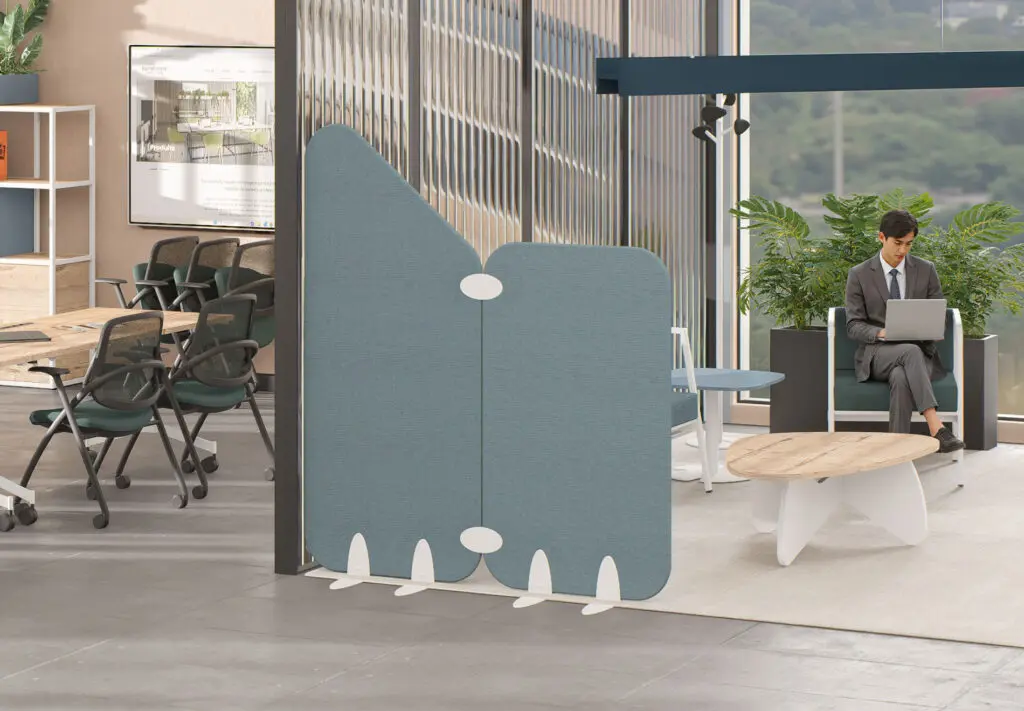
Prioritize natural light. Its impact on employee well-being is direct. If the room is open to the open-plan office, Bewall partitions allow you to delimit it acoustically and visually, without any construction work.
Step 3: Define the zones and uses
Dining area, low-seating relaxation area, standing social area, informal zone: each use calls for its own layout. The golden rule is simple. Each zone has dedicated furniture that encourages the right behavior.
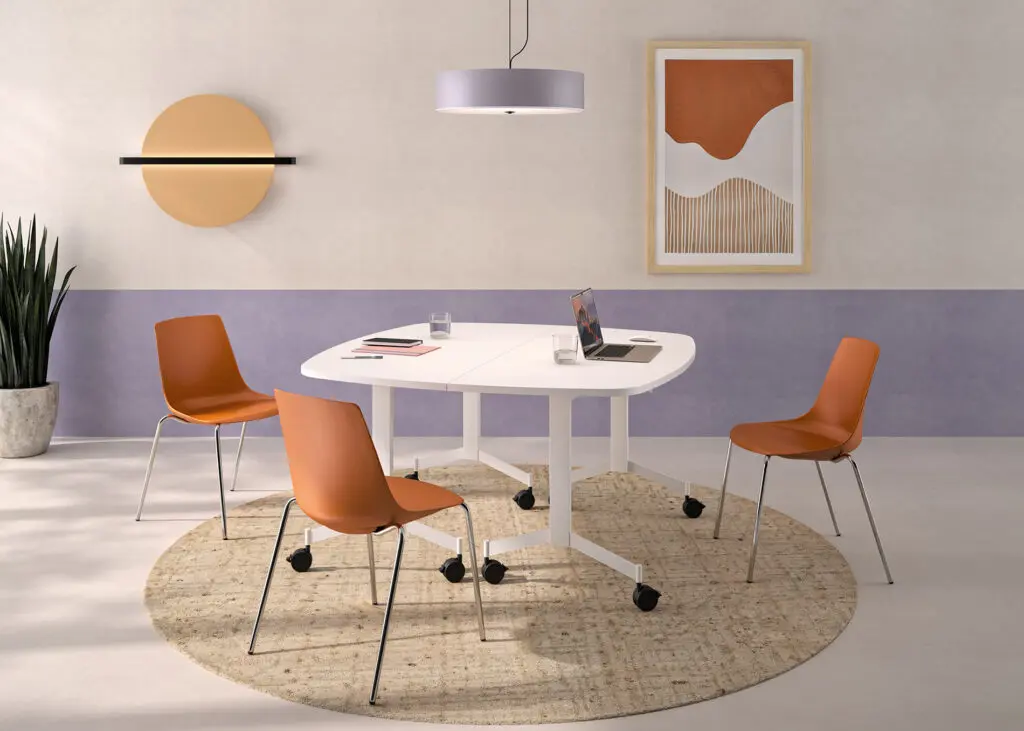
Modularity is a relevant solution. Nuanza tables on casters allow you to switch from a relaxation setup to a dining setup in seconds. The entire relaxation collection is designed with this concept of complementary zones in mind.
Step 4: Choose the furniture and equipment
Golden rule: break room furniture must be radically different from office furniture. This break is what triggers the mental switch-off. Warm materials, different colors, softer, more organic shapes.
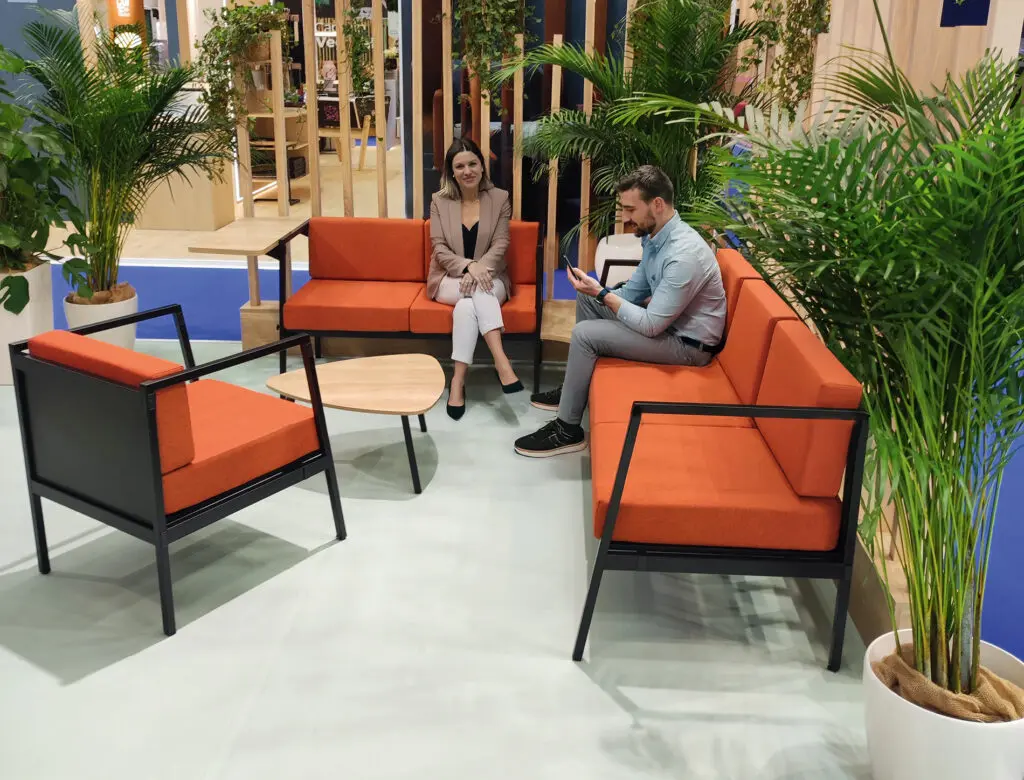
The Alto collection follows this logic. Sofas, armchairs, and side tables with organic lines and natural hues: it's designed for this type of space. As for amenities, the essentials remain: coffee machine, refrigerator, microwave, sink, and water dispenser.
Step 5: Cultivate a positive atmosphere and ensure consistency with the company's identity
A practical idea: paint one wall a bold color, different from the rest of the office. The effect on perception is immediate. Warm tones for a welcoming atmosphere. Soft tones for relaxation. Consistency with the company's visual identity remains essential, without simply replicating the office environment.
Buronomic offers an interior design consulting service that includes personalized color recommendations. Invaluable assistance in making the right choices without any missteps.
The complete checklist for setting up your break room
This checklist is organized into 6 categories so that nothing is forgotten, from the first layout to the revision of an existing space.
Category 1: Space location and configuration
- Accessible to all employees.
- Visually and acoustically separated from work areas.
- Sufficient surface area: minimum 1 m² per person, for 10% of the simultaneous staff.
- Natural light or lighting suitable for relaxation.
- Adequate ventilation.
- Location within a 100m radius of workstations.
- Clear signage from the workspaces.
- If the space is open to the open space: plan for acoustic partitions (Bewall buronomic partitions).
Category 2: Furniture for relaxation and socializing
- Comfortable sofas for true relaxation (2 and 3 seats depending on the surface area).
- Individual armchairs for solo rest.
- Coffee tables or side tables for placing drinks and personal belongings.
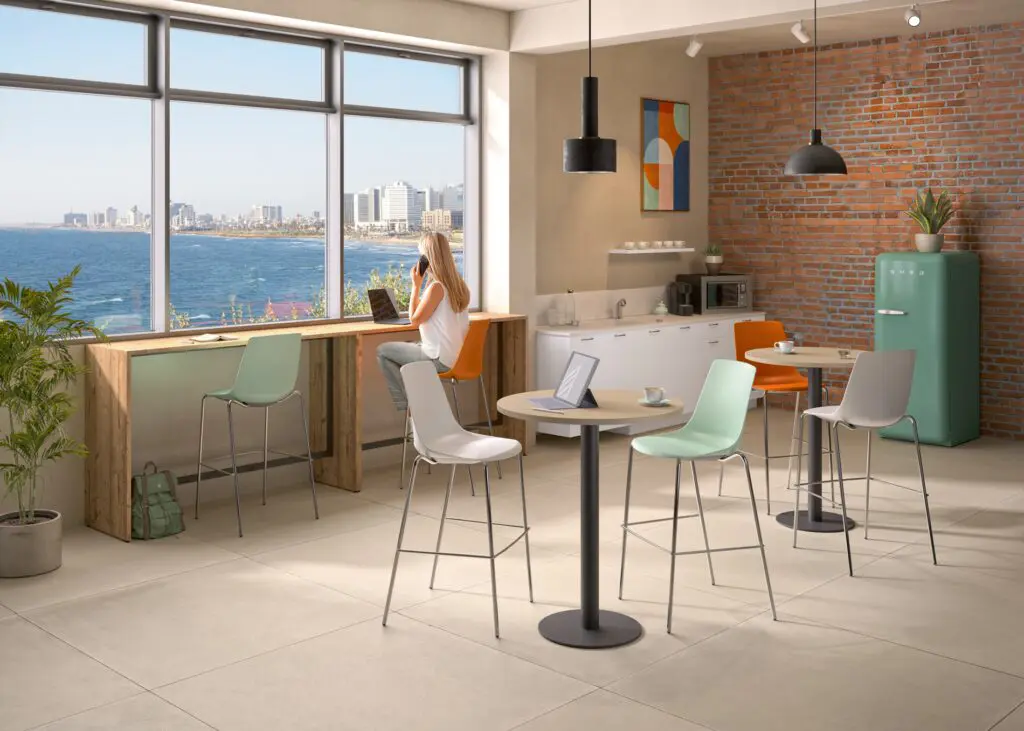
- High tables with stools for standing conversations and quick meals.
- Furniture on casters to adapt the configuration according to the time of day.
- A variety of seating options to offer different postures and cater to all profiles.
- Warm materials: washable fabric, wood, matte finishes.
On the office side, the offer covers all needs: Alto 2-seater sofa, Alto 3-seater sofa, Alto armchair, Alto side tables, Nuanza high tables (on casters), Détente tables, Astrolite high tables, Ara stools, Détente stools and Calme alcoves for a more intimate rest area.
Category 3: Catering and comfort equipment
- Coffee machine or coffee point accessible and well positioned (strategic passage point).
- Refrigerator (mandatory for companies with 50 or more employees).
- Microwave (mandatory for companies with 50 or more employees).
- Water point: hot and cold water tap.
- Self-service water fountain.
- Closed storage for personal belongings and food.
- Sufficient clearance around the equipment to avoid queues during peak hours.
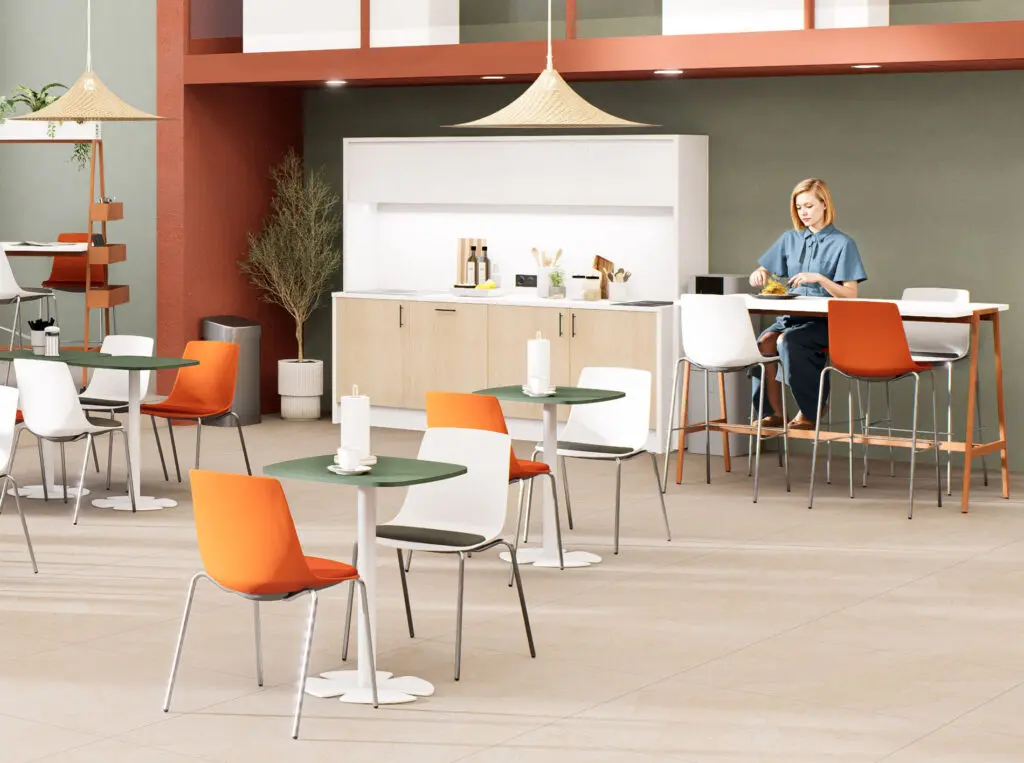
The Oasys kitchenette is available in several configurations. With an integrated sink, upper and lower storage, and compatibility with a professional coffee machine, it includes all the essential functions for a restaurant. Relaxation stools complete the coffee area, while Quiétude storage units keep personal belongings organized.
Category 4: Acoustics and space separation
The break room is inherently noisy: conversations, washing dishes, laughter. There are two distinct issues to address: isolating the room from the work areas and improving the acoustic comfort within the room itself.
- Acoustic insulation of the room in relation to the work areas.
- Partitions or dividers to distinguish areas within the room, without a fixed wall.
- Absorbent floor coverings: rugs, carpets.
- Fabric furniture to absorb sound waves inside the room.
- Natural plants: acoustic impact and well-being effect.
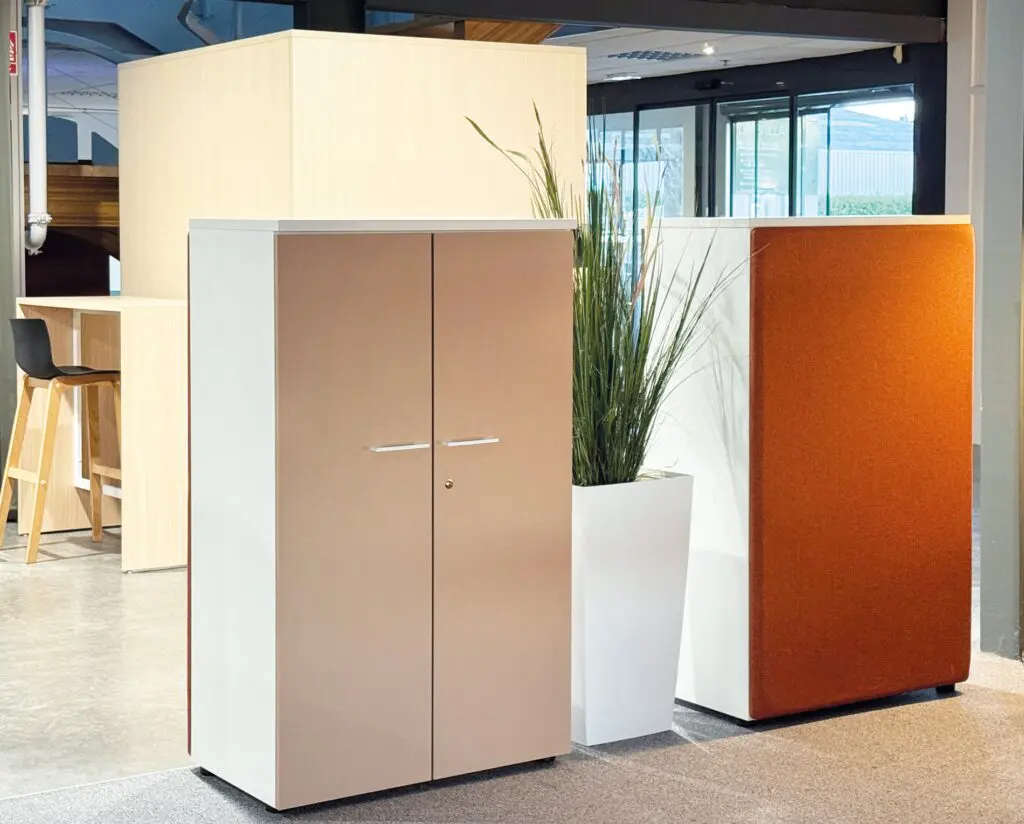
Bewall partitions are modular and can be installed without construction work. The Alto collection, with its absorbent fabric coverings, complements them. Quiétude storage can be used as acoustic dividers between zones.
Category 5: Atmosphere, decoration and well-being
- Radically different colours in the workspaces to promote mental disconnection.
- Warm tones (yellow, orange, terracotta) for conviviality and stimulation.
- Soft tones (blue, green, pastel) for relaxation and stress reduction.
- Consistency with the company's visual identity.
- Natural plants: air quality, soothing atmosphere, slight acoustic effect.
- The lighting is dim and warmer than in the workspaces.
- Display space for company life and works council information.
- Playful elements according to company culture: chalkboard, games, informal library.
Category 6: Maintenance and operating instructions
- Cleaning and space respect rules displayed in a positive and visual way.
- Defined responsibilities for daily maintenance.
- Process for reporting equipment failures or problems.
- Regular review of practices (annual questionnaire for employees).
- Gathering feedback to develop the space according to real needs.
What break room configuration is best suited to the size of your company?
There is no one-size-fits-all configuration. The available space, the number of employees, and the company culture all determine furniture choices. Here are three typical configurations, along with their associated Buronomic products.
| Configuration | Target workforce | Minimal furniture | Recommended furniture for Buronomic |
| Small break room | Less than 20 people. | Sofa, coffee table, coffee machine | Alto sofa, Alto side table, Ara stool, Oasys compact kitchenette |
| Intermediate break room | 20 to 50 people. | Sofas, high tables, kitchenette, acoustic partition | Alto sofa, Nuanza tables, Oasys kitchenette, Bewall partitions |
| Large social room | More than 50 people. | Separate zones, multiple furniture pieces, complete equipment | Tables and stools, office-style relaxation, alcoves, calm, storage, tranquility |
Designing a small break room: maximizing comfort in a small space
Opt for furniture with clean lines and light colors to visually enlarge the space. Furniture on casters and stackable seating save space on a daily basis.
For a room smaller than 15 m², a compact Alto sofa, a side table, and an Ara bar stool may suffice. The compact version of the Oasys kitchenette integrates all the catering equipment without cluttering the space.
Setting up an intermediate break room: creating distinct zones
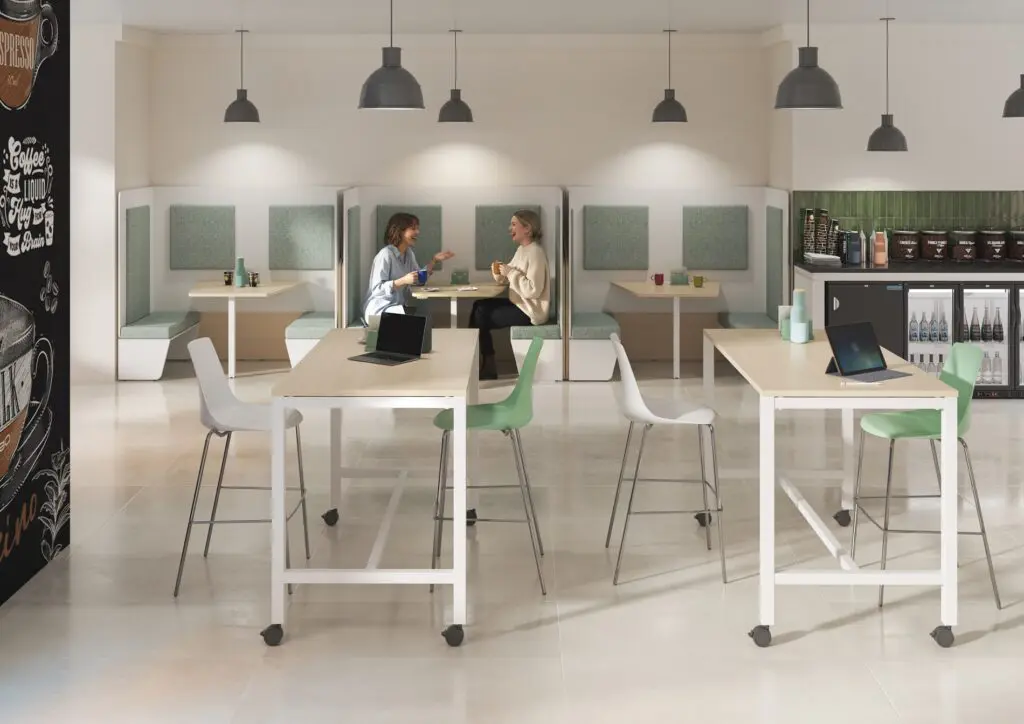
The surface area allows for a clear separation between a seated relaxation zone and a standing social zone. The Nuanza high tables on casters allow for quick reconfiguration of the space to suit different uses.
Bewall partitions delineate work-free zones and absorb noise. The Oasys kitchenette in its standard configuration, with upper and lower storage units, completes the layout.
Creating a large communal room: a living space in its own right
Several clearly defined zones coexist: a restaurant, a lounge area, a social area for standing, and an information space. The Calm alcoves create more intimate rest areas within the main hall.
The Quiétude storage units act as acoustic dividers between zones. The overall aesthetic consistency is ensured by the Buronomic collections.
Frequently asked questions about break room design
How to set up a break room in a small space?
Opt for compact, stackable furniture on casters. Avoid built-in pieces that restrict the layout. Light colors and careful lighting visually enlarge the space. For office-style furniture, there are many suitable options: the Alto 2-seater sofa, stackable Ara stools, the compact Oasys kitchenette, and Nuanza tables on casters.
What colors should I choose for a break room?
Warm tones (yellow, orange, terracotta) encourage conviviality and interaction. Soft tones (green, blue, beige) promote relaxation and stress reduction. The golden rule remains the same: choose colors radically different from those in the workspace to trigger a mental break. Consistency with the company's visual identity must be maintained, without replicating the office atmosphere.
How to improve the acoustics of a break room without construction work?
Movable acoustic partitions allow for the delimitation and isolation of the space. Fabric furniture and rugs absorb sound waves within the room. Natural plants add a slight additional absorption effect. For office-based solutions, three elements can be combined: Bewall partitions, the Alto collection (fabric coverings), and Quiétude storage units as dividers.
What size area should be allocated for a break room?
The general rule is to allow 1 square meter per person, to accommodate approximately 10% of the workforce at any one time. For more than 200 employees, it is preferable to plan for several separate spaces. There is no legal minimum surface area: the choice should be guided by user comfort.
The break room is no longer a secondary space. It is an integral component of the work environment.
The checklist presented in this article is organized into six categories: location and layout, furniture for relaxation and socializing, catering equipment, acoustics and separation, ambiance and decoration, and maintenance and usage guidelines. It's a framework that can be used immediately, whether the project involves creating a new space or redesigning an existing one.
Three configurations are available depending on the size of the company: a small break room (fewer than 20 people), a medium-sized room (20 to 50 people), and a large social room (more than 50 people). Each configuration has its own dedicated Buronomic products.