More than half of coworking users say they left a space because of noise, even before price and location. It's the number one reason for leaving, ahead of all other criteria. This statistic alone sums up the importance of a successful coworking space design.
Coworking presents a fundamental contradiction. It promises flexibility, collaboration, and productivity. But when the layout is flawed, it delivers constant noise, uncomfortable workstations, and no quiet areas. Coworkers know this.
The buronomic perspective is clear. Designing a coworking space means simultaneously resolving three contradictions: offering openness without noise, flexibility without discomfort, and collaboration without distraction. This is precisely what the buronomic collections have been enabling for over 45 years.
This article offers you the 6 essential zones with their precise ratios, the furniture adapted to each space, acoustic solutions without construction work, mistakes to avoid and Buronomic products for each use.
The 3 principles that make the difference between a popular coworking space and a deserted one
Before furnishing, these three principles structure everything else. Ignoring them means risking a space that empties in a few months.
Principle 1: Each use has its own space and furniture. A coworking space is not a giant open-plan office. It's a collection of clearly defined zones, each dedicated to a specific need. This differentiation is what justifies the subscription fee, compared to a café with Wi-Fi.
Principle 2: Identify the dominant profiles before designing. Freelance nomads, employees in internal flex offices, transient teams: their needs differ. These directly influence the choice of furniture, the ratio between zones, and the level of technological equipment.
Principle 3: Organize traffic flow before furnishing. Mark out circulation routes (120 cm for main aisles, 80 cm for secondary passages). Separate noisy areas from quiet areas. Check the available surface area per workstation: a minimum of 10 m² per coworker, including circulation areas, according to the INRS (French National Research and Safety Institute for the Prevention of Occupational Accidents and Diseases).
The 6 essential zones of a coworking space
Each zone addresses a specific need and requires dedicated furniture. The ratio between zones determines the overall quality of the experience. Here is the recommended distribution:
- 60 % in workstations.
- 20 % in a meeting and focused.
- 10 % Relaxed.
- 10 % in circulation and reception.
Zone 1: Individual workstations, the heart of coworking
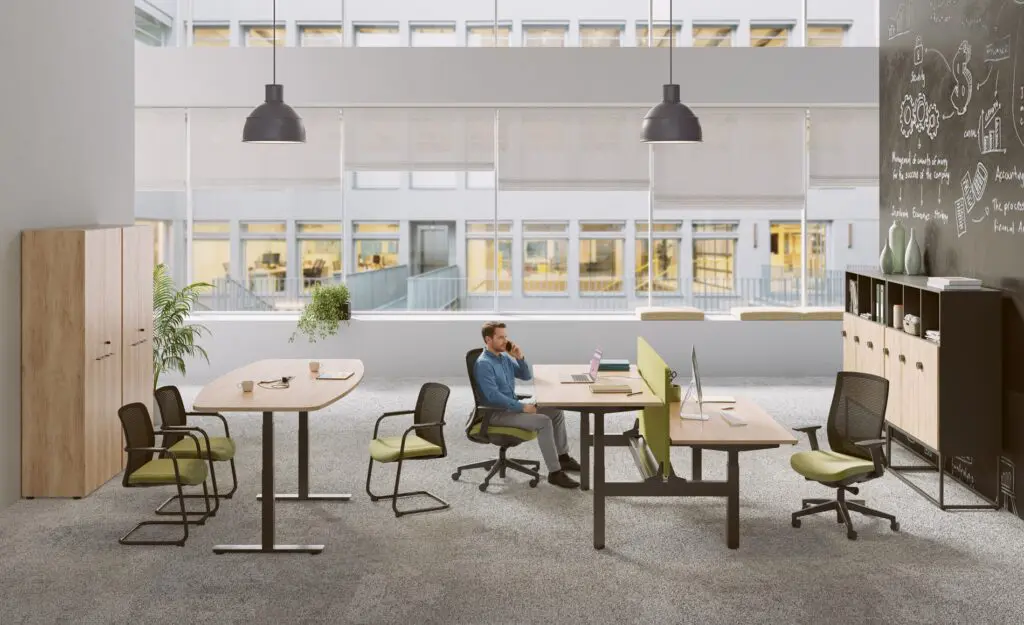
The specific needs of coworking. Workstations are flexible, non-assigned, and accessible via free seating. Three to five different users pass through the same workstation each day. Wear and tear is three to five times greater than in a traditional office. Body types vary considerably and change frequently.
The specific constraints of coworking. A fixed desk at 72 cm is unsuitable for everyone, especially in a high-turnover environment. Without motorized adjustment, the sit-stand desk is never used. In shared coworking spaces, this is even more critical than in a traditional office, since the user changes with each session. The workstation must be completely cleared at the end of the session: no personal storage under the desk.
Common mistakes: Installing identical fixed desks for all workstations, without considering individual body types. Forgetting acoustic partitions between adjacent workstations. Not providing individual lockers separate from the workstation.
Recommended ratios: 10% fixed standing workstations (high tables) for coworkers who only stay for 1 to 2 hours. 1 individual lockable locker for every 1.5 workstations available on the floor.
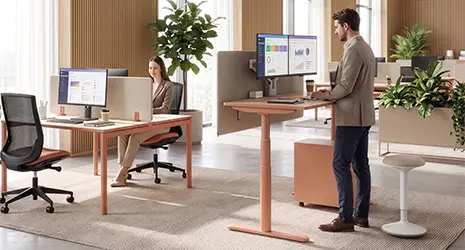
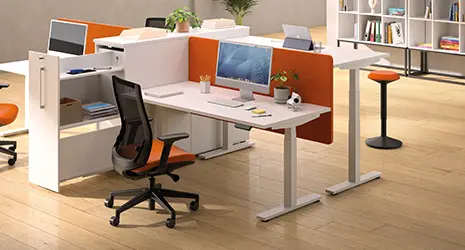
Envol Evo electric height-adjustable desks offer quiet motorized adjustment, user position memory, and a height range of 63 to 128 cm. They accommodate all body types. 5-year warranty. The Nuanza bench offers 120 cm per workstation, 80 cm depth, and a reconfigurable configuration. Nuanza high tables on casters are used for standing workstations (10% of the total). Envol acoustic dividers are installed between adjacent workstations. Comfort mobile pedestals with locks provide remote, individual storage.
Zone 2: Meeting rooms, the revenue-generating space
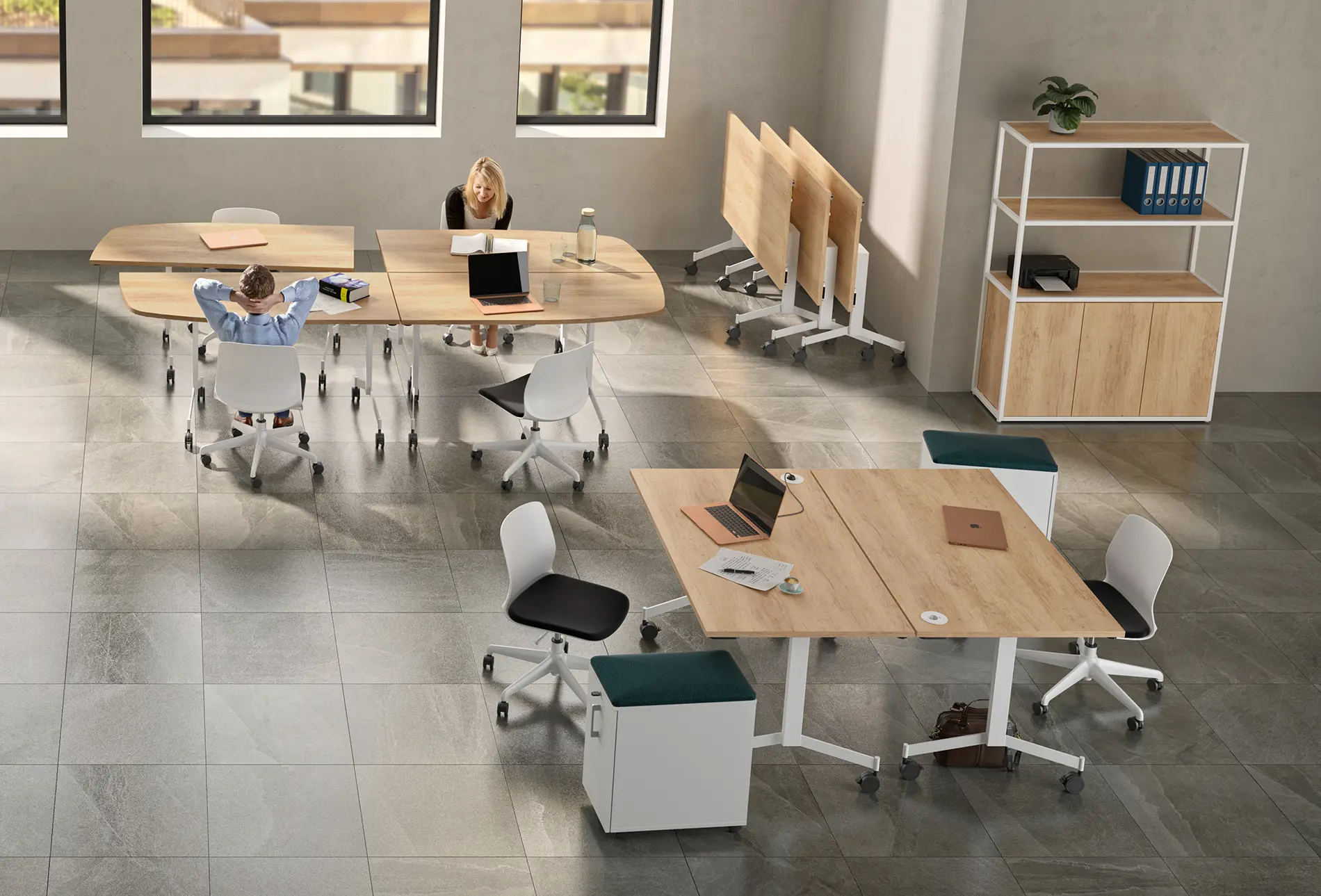
The specific needs of coworking spaces. Rooms can be booked by the hour or by the day. They often represent the primary source of supplemental income. They must be able to accommodate 4 people in the morning and 12 in the afternoon without significant reconfiguration. They generate noise to the outside and are sensitive to external noise.
The specific challenges of coworking. Users don't know each other and speak louder than in a traditional office. Enhanced acoustics are essential. The room must be reconfigurable by the users themselves, without external assistance. Technical equipment must be planned in advance: interactive screen, video conferencing system, and connectivity throughout the space.
Common mistakes: Fixed, non-movable tables that restrict layouts; heavy chairs that are difficult to move alone; untreated acoustics that disturb adjacent coworkers.
Recommended ratios: 1 meeting room for 10 to 12 workstations. Plan for two documented and tested configurations for each room: one for 4 people and one for 12 people.
fliptop fliptop tables are foldable, on casters, and combinable. They can accommodate from 4 to 12 people in minutes. The Astro table is suitable for formal, fixed meeting rooms, seating up to 12 people, and features a contemporary design. Libellule chairs are lightweight, stackable, and ergonomic. They are easy to move by one person. Bewall partitions provide sound insulation between the meeting room and the open-plan space.
Zone 3: Spaces for concentration and privacy, the difference between good and excellent
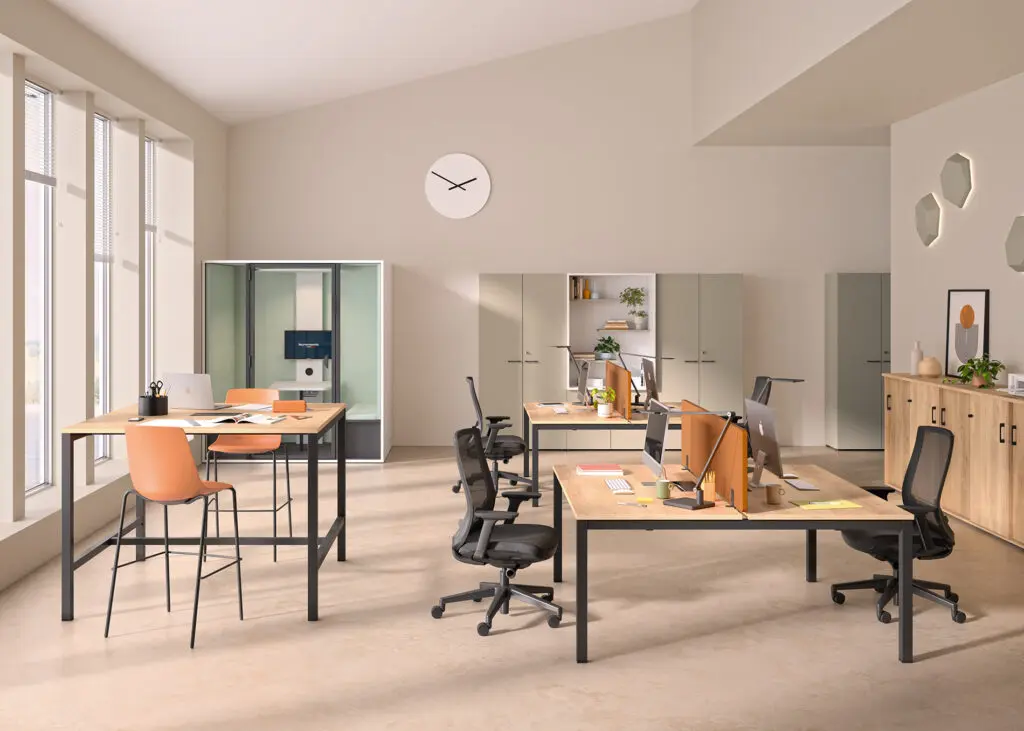
The specific need for coworking. If this area is lacking, the coworker will work in the café. This is the most differentiating factor compared to a library or a café with Wi-Fi. Two levels of need coexist: partial isolation for short calls and 30- to 60-minute periods of focused work, and total isolation for video conferencing, interviews, and deep work.
The specific constraints of coworking. An Alto alcove replaces a meeting room for 80% of uses by 1 or 2 people, without reservation. An Essential booth used 6 times a day for 1 hour per session represents 6 hours of daily usage value. It is often the first piece of equipment for which coworkers are willing to pay extra. Sales professionals, consultants, and HR professionals need complete privacy: an alcove is not enough.
Common mistakes: Underestimating the number of alcoves and booths relative to actual usage. Placing alcoves in the center of the floor plan, in high-traffic areas. Confusing alcoves with booths: partial vs. total isolation; they are not interchangeable.
Recommended ratios: 1 alcove for 6 workstations in a mixed-use space. 1 booth for 10 workstations in a space with moderate telephone activity. 1 booth for 6 workstations in a space with high telephone activity (sales, consulting, recruitment).
The privacy booths are available in 4- and 6-person versions. They feature absorbent fabric, a wraparound backrest, and partial insulation suitable for short-term use. The acoustic booth offers insulation up to -30.3 dB. It includes an integrated seat and shelf, glazing, and ventilation. Available in 1- and 2-person versions, without floor anchoring.
Zone 4: Informal collaboration spaces, the heart of networking
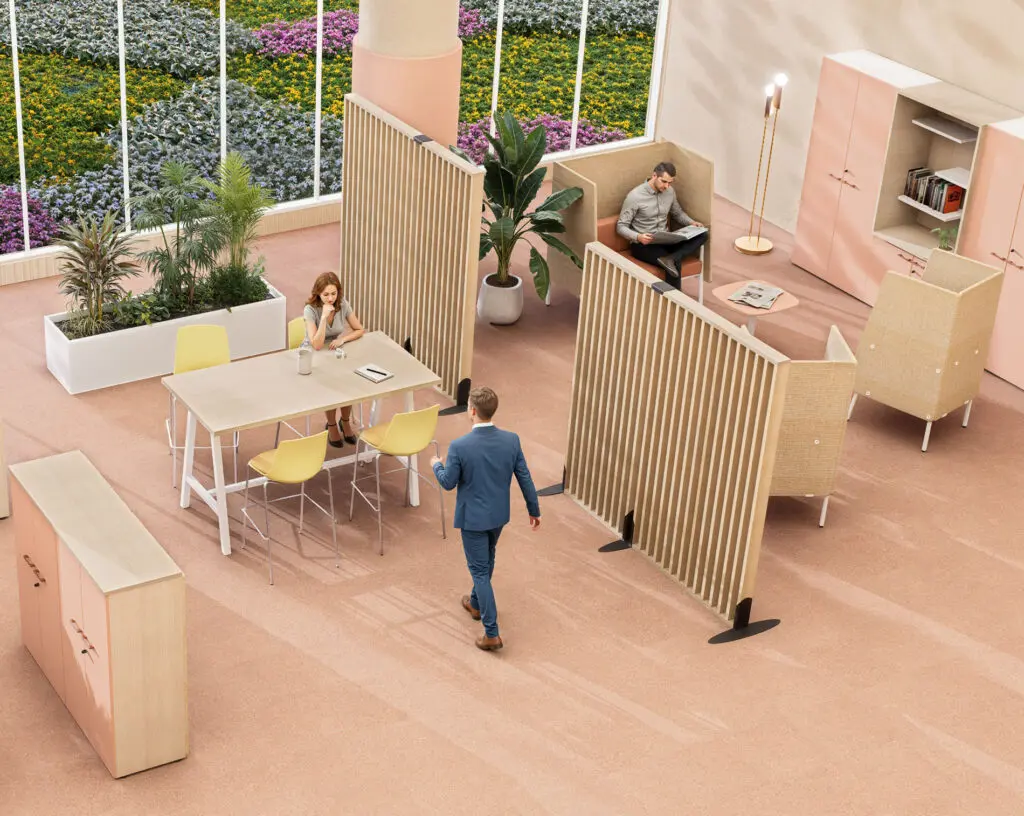
The specific needs of coworking. Coworkers don't necessarily know each other. These spaces are networking areas as much as workspaces. Spontaneous exchanges between 2 or 4 people shouldn't require booking a meeting room.
The specific constraints of coworking. The area must be acoustically contained to avoid disturbing neighboring workstations. The furniture must be able to serve as a stand-up meeting space in the morning and a networking counter during evening events. The Calme alcoves create a natural setting for conversation that limits noise transmission to the outside.
Common mistakes: Placing these areas in the center of the floor, where their residual noise spreads in all directions. Undersizing the number of spaces relative to the number of workstations.
Recommended ratio: 1 informal collaboration space for every 8 workstations.
The Calme alcoves are semi-enclosed and lined with absorbent fabric, creating a space for conversation. The Nuanza high tables on casters offer dual functionality: stand-up meetings in the morning and networking in the evening. The Astrolite high tables provide a mobile bar-style setup. Stackable Ara stools and Détente stools complete the arrangement.
Zone 5: the relaxation and dining area, the loyalty factor
The specific needs of coworking. A coworker stays up to 8 hours on site. The relaxation area isn't a bonus; it's a direct factor in building loyalty. Coworkers who have lunch there return more regularly and develop a sense of belonging to the space.
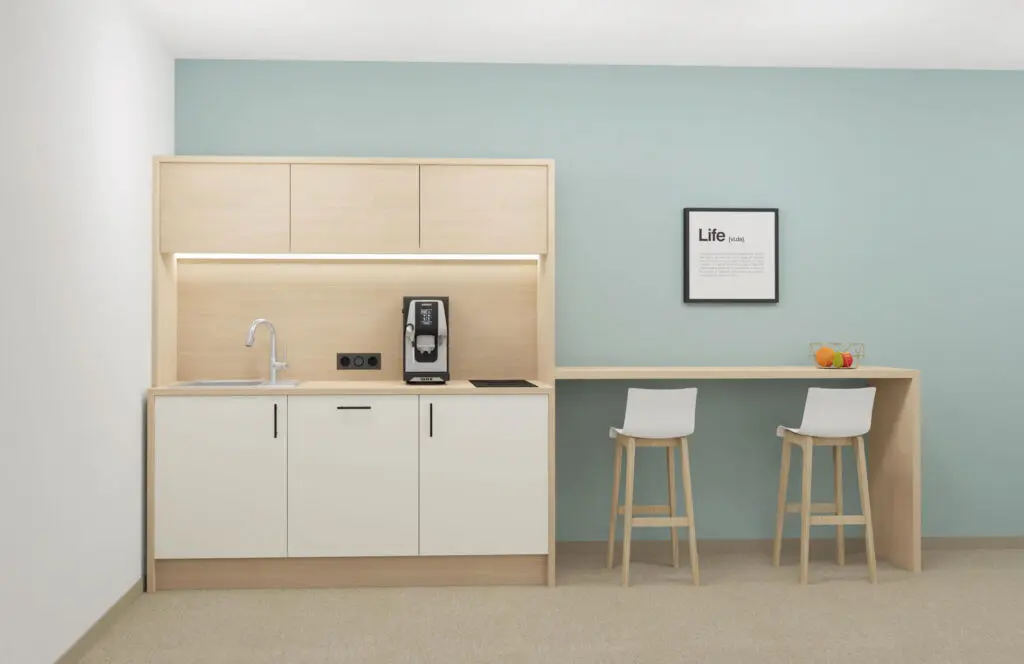
The specific challenges of coworking. A kitchenette that isn't sized for the flow of users creates bottlenecks during peak hours. Immediate frustration and a negative image result. A practical rule of thumb: provide two microwaves and two coffee machines for every 20 workstations. The fabric furniture from the Alto collection serves a dual purpose: comfortable breaks and sound absorption in the space.
Common mistakes: Furnishing the break area with hard furniture (plastic, bare metal, bare wood). These materials reflect sound and increase the noise level throughout the entire space. Sizing the kitchenette for 10 people in a space designed for 30 workstations.
Recommended ratios: 1 complete break area for 15 to 20 workstations. Minimum area of the break area: 1 m² per person for 10% of the workforce at any one time.
The Alto 2- and 3-seater sofas and armchairs feature absorbent, durable upholstery. The Alto side tables combine a wooden top with a metal base. The Nuanza and Astrolite high tables provide a convivial standing space. The Ara and Détente stools complete the collection. The kitchenette or tea room is available in several configurations, with an integrated sink compatible with a professional coffee machine, and upper and lower storage.
Zone 6: The reception area, the first and last impression
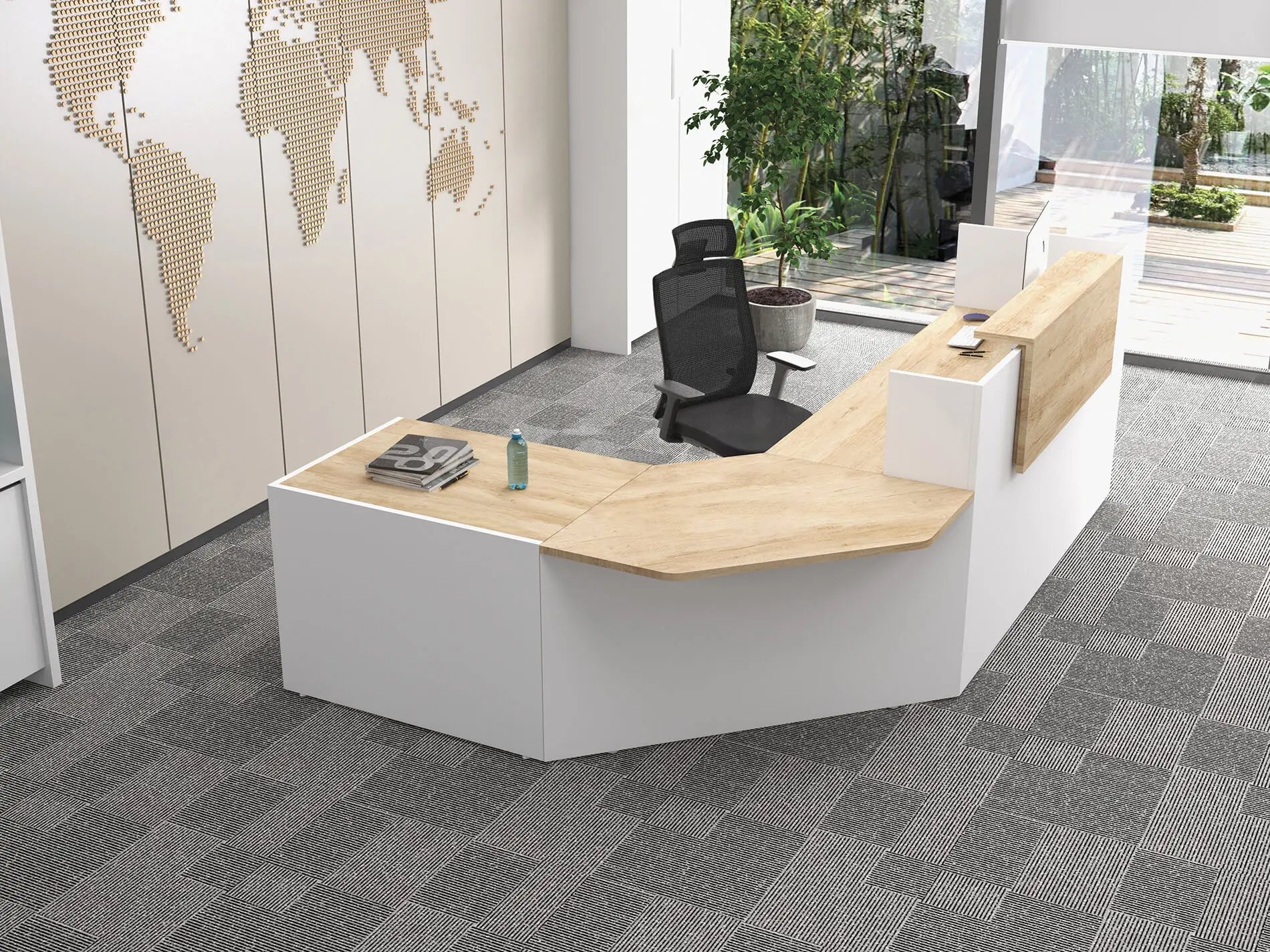
The specific needs of coworking spaces. The reception area influences the decision to return. A poorly designed reception area immediately gives the impression of an amateurish space. It must be simultaneously functional for the manager and welcoming for the visitor.
The specific constraints of coworking. The waiting area is often overlooked in coworking projects. A visitor without a waiting area is a visitor who feels unwelcome. The reception desk must be adaptable for standing or sitting depending on the time of day. Signage from reception to all areas must be clear: a coworker who gets lost at the entrance won't come back.
Common mistakes. Reception area without an associated waiting area. Reception desk without built-in storage for administrative staff. Lack of aesthetic consistency between the reception area and the rest of the space.
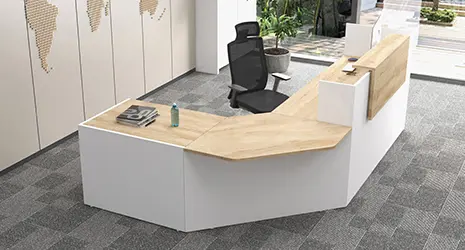
The reception desks offer a contemporary design with standing/seating options. The modern and contemporary Fifty-Full reception desk provides an expanded configuration for high-traffic areas. Alto sofas and armchairs furnish the waiting area opposite the reception desk.
Coworking space furniture: 5 non-negotiable criteria
The furniture in a coworking space is subject to specific constraints, different from those of a traditional office. The following table summarizes the issues by criterion.
| Criteria | Why criticize coworking? | Common mistake | Buronomic solution |
| Modularity | 3 to 5 users per workstation per day | Fixed furniture cannot be reconfigured | Eureka folding tables, Bewall mobile |
| Ergonomics | Very varied body types | Fixed office unsuitable for 40% of profiles | Envol Evo + adjustable seats |
| Sustainability | Usage 3 to 5 times greater than a traditional office desk | Consumer furniture worn out in 2 years | Buronomic guarantee: 5 or 10 years depending on the model |
| Acoustic | Noise = Number 1 reason for leaving | Hard furniture that reflects sound | Alto Collection, Bewall, dividers |
| Visual consistency | Strong identity = loyalty | A mix of incoherent furniture | coordinated collections buronomic |
How to improve the acoustics of a coworking space without structural work
Why acoustics is the number one issue in coworking
40% of coworkers leave a space because of noise. It's the number one reason for leaving, even more so than price.
The NF S 31-080 standard sets a clear framework: between 40 and 55 dB depending on the activity. An untreated coworking space regularly exceeds 65 dB. Three sources of noise coexist in a coworking environment: conversations, phone calls, and impact and movement noise.
Two complementary strategies can be used to address this. Absorption, which reduces reverberation, and separation, which blocks propagation. The best solutions combine both.
The 4 acoustic solutions that don't require construction work, in order of effectiveness
| Solution | Efficiency | Use | Buronomic product |
| Acoustic booth | Maximum, up to -30 dB | Video conferencing, interviews, deep work | Essential Cabin |
| Acoustic alcove | Intermediate | Short calls, focused attention | Alcoves Alto |
| Movable partitions | Raised in the area | Separation between zones | Bewall Partitions |
| Absorbent fabric furniture | Passive but significant | All areas for relaxation and collaboration | Alto Collection, Envol dividers |
What acoustic treatment is appropriate for the area?
| Area | Target | Priority solutions | Buronomic products |
| Workstations | 40 to 50 dB | Separators + Bewall | Envol and Bewall separators |
| Meeting room | 45 to 55 dB | Bewall + fabric furniture | Bewall, Dragonfly chairs |
| Relaxation area | 50 to 60 dB | Upholstered furniture + Tranquility | Alto Sofa and Armchair, Quietude |
| Alcove | 40 to 50 dB | Tall, absorbent files | Alcoves Alto |
| Cabin | 35 to 45 dB | Total isolation | Essential Cabin |
Space planning and configuration according to the available surface area
Here are the recommended configurations according to the surface area, with the ratios per zone and the associated Buronomic products.
| Surface | Workstations | Meeting rooms | Alcoves | Cabins | Relaxation | Home |
| Less than 100 m² | 8 to 12 positions | 1 room for 6 people. | 1 to 2 | 0 to 1 | Mini coffee corner | Integrated |
| 100 to 300 m² | 20 to 40 positions | 2 rooms (4 and 8 people) | 2 to 4 | 1 to 2 | Lounge area + kitchenette | Reception desk |
| Over 300 m² | 50 positions and more | 3 rooms (4, 8, 12 people) | 4 to 8 | 3 to 6 | Large separate room | Dedicated reception + waiting |
Setting up a small coworking space (less than 100 m²)
The priority is total versatility. Each area must be able to change use quickly. Eureka folding tables on casters transform the open space into a meeting room in minutes. Bewall mobile partitions reconfigure the space without construction work.
Minimum viable configuration: 8 Envol Evo workstations, 1 Eureka table, 1 Alto alcove, Oasys mini kitchenette, Comfort cabinets. This is sufficient to open with a credible and scalable offering.
Setting up a medium-sized coworking space (100 to 300 m²)
The layout allows for a clear distinction between quiet and collaborative areas. Plan for two meeting rooms of different sizes, complemented by one or two acoustic booths. A separate relaxation area with Alto furniture and a standard Oasys kitchenette enhances the customer experience.
The reference ratio remains applicable: 60% workstations, 20% meetings and concentration, 10% relaxation, 10% circulation and reception.
To set up a large coworking space (over 300 m²)
Several distinct work areas coexist: a collaborative open space, a quiet zone, and standing workstations. Multiple meeting rooms cater to all capacities: 4, 8, and 12 people, with tables adapted accordingly.
A large relaxation area with a fully equipped kitchenette is essential. Include at least two coffee machines and two microwaves. The Buronomic project service supports this type of setup with 3D visualization and comprehensive guidance.
Regulations and practical aspects for a coworking space
Legal obligations according to the type of space
Public access building (ERP) classification is mandatory based on capacity. Category 5 includes spaces accommodating fewer than 100 people, with basic fire safety standards. Higher categories impose stricter requirements: regulatory exits, compartmentalization.
Accessibility for people with reduced mobility (PRM) is non-negotiable: minimum passage width (90 cm), adapted workstation height, and access to restrooms. Fire safety requires mandatory exits, fire-resistant partitions, and standardized signage.
In terms of materials, all Buronomic furniture complies with current standards.
Additional services to retain coworkers
Business address services, mail reception, telephone answering service: these are all services that transform a coworking space into a fully-fledged professional partner.
Access to printers and professional office equipment remains standard. A room and workstation booking application enhances the user experience. On the security front, secure individual lockers are essential. Comfort buronomic mobile pedestals, equipped with locks, meet this need with a ratio of 1 locker per 1.5 workstations.
The 6 most common mistakes in designing a coworking space
Mistake 1: Not planning for quiet zones
A coworking space without a quiet zone loses its users who need to concentrate. The non-negotiable minimum is clear: 1 Alto alcove for 6 workstations, 1 Essential booth for 10 workstations.
Mistake 2: Choosing fixed, non-modular furniture
The layout changes several times a week depending on bookings and events. The practical rule is unchanging: any piece of furniture weighing over 50 kg without casters hinders flexibility. Eureka tables on casters and stackable Libellule chairs are recommended as standard.
Mistake 3: Forgetting individual lockers
A non-assigned workstation without an associated locker becomes a cluttered space for personal belongings. The required ratio is: 1 Eko locker with a lock for every 1.5 available workstations.
Mistake 4: Installing hard furniture that worsens the noise
Bare metal, hardwood, plastic: these materials reflect sound and worsen the overall noise level. Replace them with upholstered furniture, such as the Alto collection, which naturally absorbs sound waves.
Mistake 5: Neglecting ergonomics on shared workstations
Coworkers of very different body types sit at the same workstations. A fixed desk at 72 cm is unsuitable for 40% of users. The non-negotiable standard: Envol Evo electric desks with position memory.
Mistake 6: Mixing furniture without aesthetic coherence
A mismatched furniture mix detracts from the image of a coworking space and the sense of belonging. Choose coordinated collections in the same finishes and colors. All Buronomic collections are available in coordinated finishes.
A successful coworking space rests on three pillars: clearly defined and differentiated zones, with the right ratios; modular and ergonomic furniture, resistant to intensive use; and controlled acoustics without structural work.
Six mistakes should never be made. No quiet zone. Fixed furniture. Lockers not provided. Hard furniture that amplifies noise. Neglected ergonomics. Inconsistent aesthetics. Each one compromises the user experience and customer loyalty.