The kitchen area is often the last space considered when designing an office. Yet, it's the first space visited each morning by all employees. The coffee machine, the refrigerator, the microwave: these are all essential elements that structure the day.
Much more than just a sink and a microwave, the kitchen area is the informal heart of company life. It's a place to disconnect, for spontaneous exchanges, and for team cohesion. Its quality directly influences the overall atmosphere of the workplace.
The challenge lies between two poles. On one side, the legal obligation, often minimal. On the other, the strategic opportunity: fostering a friendly atmosphere, building loyalty, and strengthening employer branding. Many companies stop at the bare minimum required by regulations. They miss out on a powerful lever for improving quality of work life.
In 45 years of manufacturing professional furniture, buronomic has developed solutions specifically designed for these hybrid, functional, and user-friendly spaces. The Oasys tea room, the Détente tables, the Alto collection: these are just some of the solutions adapted to every size of company.
This article offers you a complete overview: legal obligations per workforce, configurations according to surface area, furniture adapted to each zone and specific office products for each use.
Kitchen space in the workplace: what exactly are we talking about?
The distinction between corporate kitchens and professional catering kitchens
A preliminary distinction is necessary to avoid confusion. The two universes are governed by different rules.
Professional catering kitchens serve restaurants, caterers, and hotels. They are subject to HACCP standards. Cold rooms, stainless steel worktops, and a forward flow system: their operation is governed by a complex regulatory framework.
The company kitchen or break room is a space dedicated to employees for meals and breaks. It is subject to the French Labor Code and public access building (ERP) regulations. Buronomic specializes in this latter category, providing furniture and break rooms designed for employee dining and social spaces.
The different types of kitchen spaces in the workplace
Several configurations coexist depending on the size of the company and the available space.
- The compact tea room is an integrated unit that combines a sink, storage, and space for equipment. It's the ideal solution for small teams.
- The dedicated dining area is a separate room, equipped with dining furniture. This setup is reserved for companies with more than 50 employees, in accordance with the French Labor Code.
- The open cafeteria is an open space integrated into the open office. It combines a coffee corner, high tables and a social area in a fluid layout.
- The large dining hall caters to companies with more than 200 employees, with several distinct zones to accommodate a high volume of customers.
What the law says about kitchen space in the workplace
Legal obligations according to workforce size
| Effective | Obligation | Minimum equipment required |
| Fewer than 25 employees | Clean and secure space | No equipment required, no cooktop or oven |
| 25 to 49 employees | Equipped dining area | Refrigerator, water point, means of reheating food |
| 50 employees or more | Restaurant premises | Refrigerator, microwave, water point, sufficient number of tables and chairs |
| More than 200 employees | Reinforced catering area | Same base with accommodation capacity proportional to the number of employees |
The 25-employee rule and cooking equipment
For establishments with fewer than 25 employees, public access building regulations prohibit the installation of cooktops and ovens in the kitchen area. The reason is simple: fire safety. Fire protection standards are not suitable for this type of equipment in small businesses.
For companies with more than 25 employees and a dedicated space, cooktops and ovens are permitted, subject to compliance with applicable public access building regulations. The Oasys tea room can be configured with or without a ceramic cooktop, depending on your company's needs and regulations.
Hygiene and safety standards to be observed
Several regulations apply. Public access building (ERP) compliance applies to areas open to visitors. Food hygiene regulations require washable surfaces, proper refrigeration, and organized waste management. Ventilation is mandatory: the kitchen must have a suitable ventilation system. Finally, accessibility for people with reduced mobility (PRM) requires minimum passage widths and accessible worktop heights.
Steps to properly design your company kitchen space
Step 1: Define the actual uses of the space
A few key questions help to define the scope of the project. Do employees heat up their meals or do they only bring sandwiches? Do they mainly take short coffee breaks or 45-minute lunches? Do they need a social space or simply a food service area?
These answers directly influence the choice of equipment and furniture. The Buronomic recommendation: consult the teams before starting. Their actual usage is often different from what one might imagine.
Step 2: Choose the right location
The kitchen area should be separate from the work areas. This distance allows for a true mental break and prevents noise pollution. Prioritize natural light: its impact on the atmosphere and well-being is immediate.
Ventilation is a key consideration. The kitchen area generates odors and humidity. Whether natural or mechanical, ventilation must be planned from the design stage. Regarding access, ensure the kitchen is located within 100 meters of the workstations to facilitate unrestricted breaks.
Step 3: Define the zones according to the available surface area
Four zones structure a well-designed kitchen space.
The equipment and preparation area includes the tea room, sink, refrigerator, microwave, and coffee machine. It is the functional heart of the space.
The seated dining area accommodates tables and chairs for meals eaten on site.
The standing social area is dedicated to quick coffee breaks, with high tables and stools.
The relaxation area, which should be planned if space allows, offers sofas and armchairs for true disconnection.
Step 4: Choose the right furniture for each area
A fundamental rule: kitchen furniture must be radically different from office furniture. This break is what triggers the mental disconnect.
Opt for easy-to-clean materials: stain-resistant fabric, treated wood, metal legs. Modularity remains a priority. Tables on casters allow you to adapt the configuration according to the number of people present and the time of day.
Step 5: Create the right atmosphere and decor
Choose distinct colors for workspaces to encourage mental disconnection. Natural plants offer three benefits: improved air quality, a calming atmosphere, and slight sound absorption. Lighting should be warmer and less intense than in offices.
Consistency with the company's visual identity remains essential. However, it's important not to replicate the office atmosphere, which would negate the desired separation effect.
The Oasys Buronomic tea room: the functional heart of the kitchen space
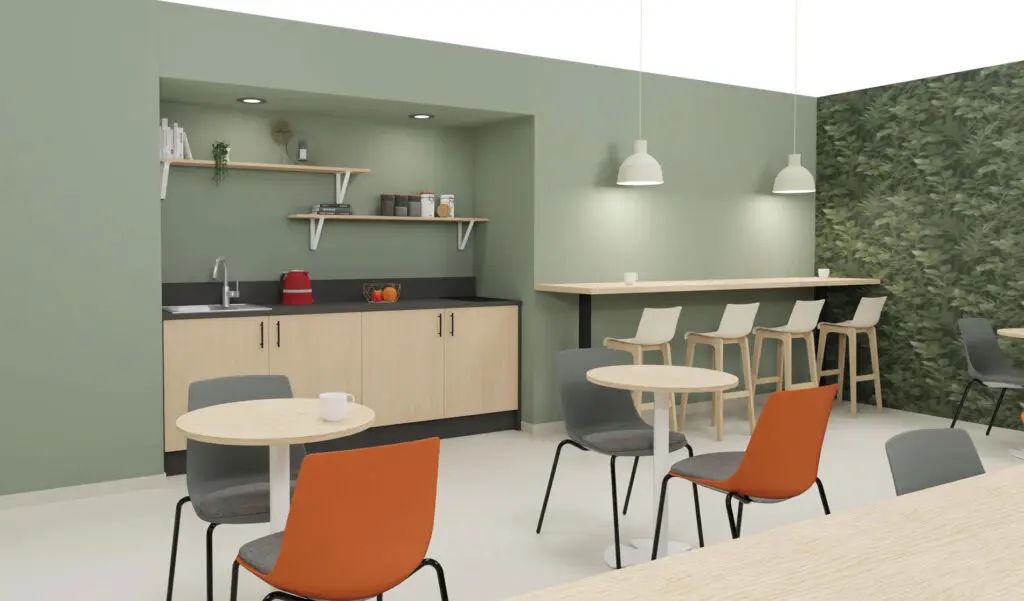
Configurable and inviting, Oasys tea rooms offer a place to relax, share a friendly moment with colleagues, or refocus in complete tranquility. Every break becomes a moment dedicated to well-being and creativity in the office.
What the Oasys tea room includes
The worktop is reversible (left/right). It can be fitted with a sink and/or a ceramic hob at the ends, according to regulations and requirements.
Several types of furniture are available: storage unit, storage unit with drawer, sink unit, built-in dishwasher, built-in refrigerator.
The tall storage unit offers 2, 3, or 4 storage compartments with hinged doors, depending on the version. A high backsplash, an integrated power strip (2 outlets + 1 switch), and an LED strip beneath the storage compartments complete the package.
Three finishes are available: Anthracite, Oak grain and White.
The available configurations depend on the surface area and the number of employees
| Configuration | Width | Depth | Height | Appropriate staffing |
| 2 pieces of furniture | 125.5 cm | 64 cm | 92 cm | Less than 20 people. |
| 3 pieces of furniture | 185.5 cm | 64 cm | 92 cm | 20 to 50 people. |
| 4 pieces of furniture | 245.5 cm | 64 cm | 92 cm | 50 people or more |
Manufacturing and warranty
The Oasys tea room is manufactured by Structa, in the heart of the Drôme region. It comes with a 3-year warranty. The worktops are made of laminate, which is easy to clean and moisture-resistant. The fronts are available in Anthracite, Oak, and White.
Why the Oasys tea room rather than a mainstream restaurant?
Three concrete reasons justify choosing a professional solution.
Intensive use is the primary concern. The Oasys tea room is designed to accommodate dozens of users per day. A standard kitchen, designed for 2 or 3 domestic users, wears out quickly in this context.
Next, the materials. Professional-grade, they are resistant to impacts, moisture, and stains. The laminate worktops are designed for daily cleaning.
Finally, consistency. The Oasys tea room is aesthetically coordinated with the other Buronomic collections, creating a cohesive space. It is delivered and installed by the Buronomic distributor network.
Furniture to complete the company kitchen space
The Oasys tea room forms the functional heart of the space. Around it, the convivial furniture transforms a simple refreshment point into a true living space.
Tables and chairs for the seated dining area
For seated meals, provide standard-height tables, rectangular or round depending on the available space. Chairs should be lightweight, easy to clean, and stackable to free up space between courses.
In terms of size, allow a minimum of 0.8 m² per person in a dining configuration, ideally 1 m² for optimal comfort.
The Nuanza tables by buronomic are available in several sizes, with a wooden top and metal base. The Ara chairs complete the setup for mixed configurations with high tables.
High tables and stools for the standing social area
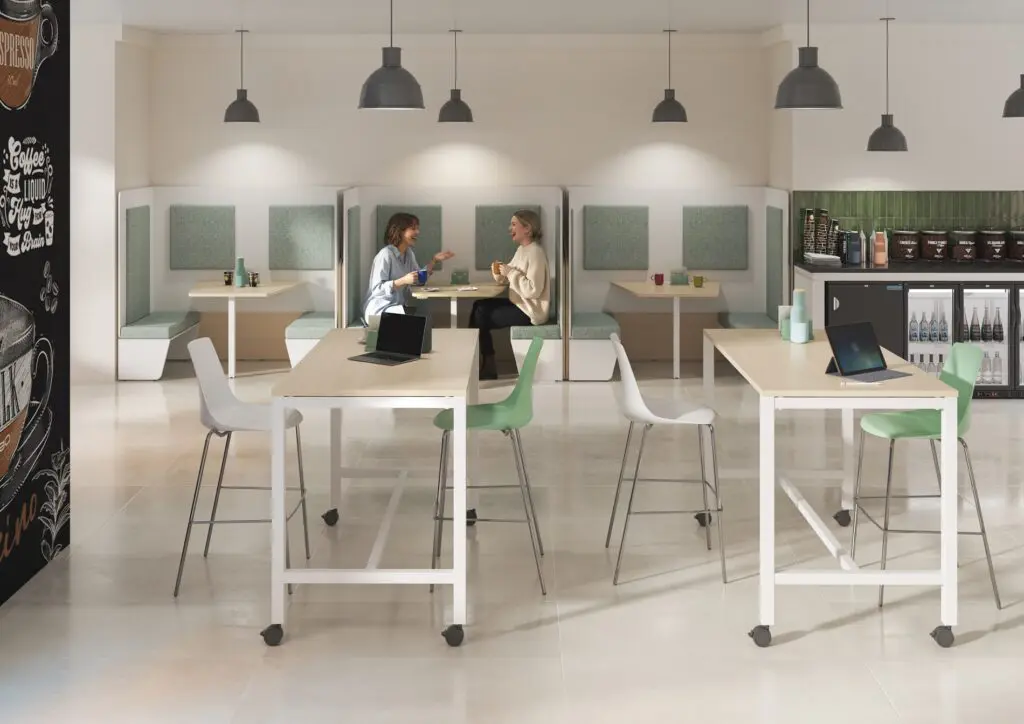
The standing format is ideal for short coffee breaks (5 to 15 minutes). It encourages quick and dynamic exchanges. The coffee area is a strategic thoroughfare: the furniture must facilitate smooth traffic flow.
The tables on wheels allow the area to be reconfigured according to the time of day.
On the office furniture side, the Nuanza high tables on casters are available in bar height and several widths. The Astrolite high tables offer a mobile bar format with a clean design. The Ara stoolsare ideal for small spaces. The Détente stools complete the range.
The lounge relaxation area for larger spaces
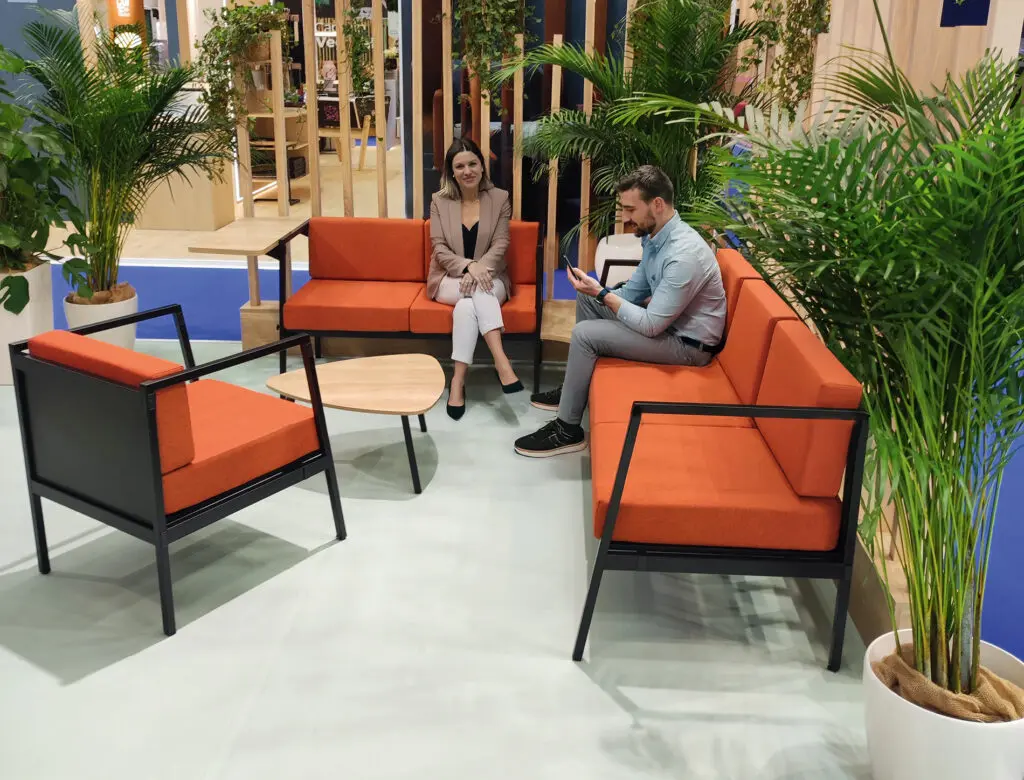
For kitchen spaces larger than 30 m², include a dedicated relaxation area with low seating. Upholstered furniture provides natural sound absorption, which is invaluable in a naturally noisy environment. Choose stain-resistant fabrics for use in a restaurant setting.
The Alto 2 and 3-seater sofas and the Alto Buronomic armchairs are ideally suited for this purpose. Durable fabric and finishes coordinated with the rest of the space ensure visual consistency.
Storage solutions for an organized kitchen space
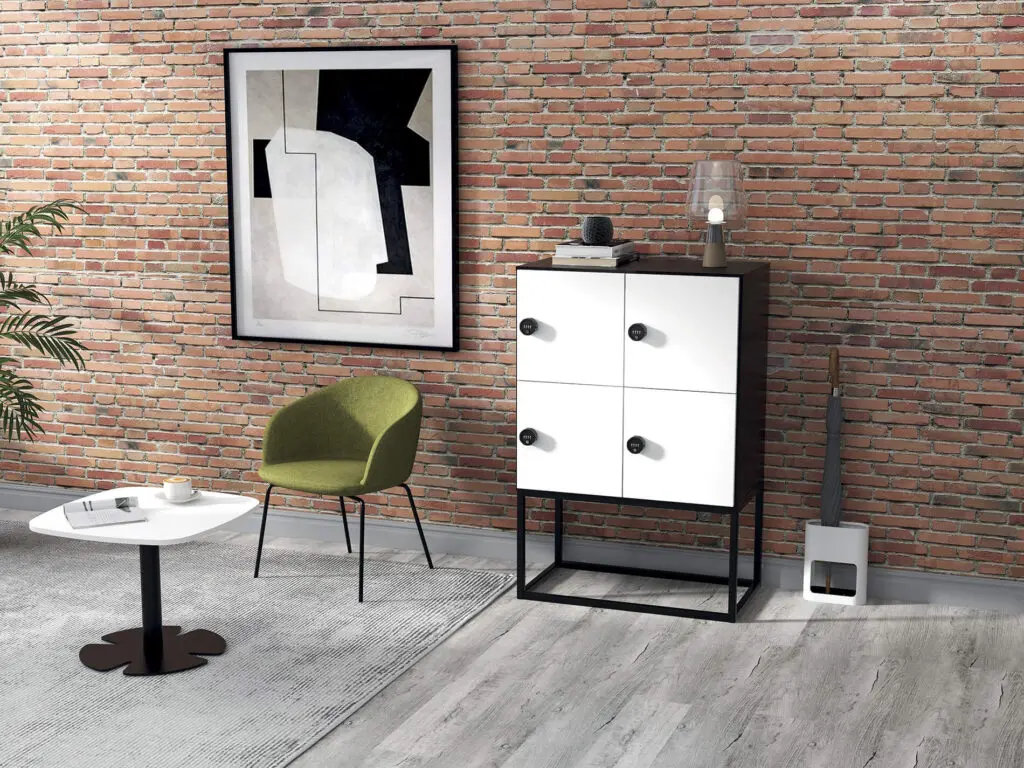
Two needs coexist: to delineate the kitchen area from the social area without blocking the light, and to provide secure individual storage.
The Quiétude low-profile storage units (104 or 136 cm) with fabric backing define areas while maintaining a visually light appearance. They also absorb sound waves. The Eko lockers provide secure individual storage.
Treating the acoustics of the kitchen space without construction work
Why acoustics is a key issue in kitchen spaces
The kitchen area is inherently noisy. Conversations, washing dishes, the coffee machine, the microwave: the sources of noise accumulate. Without treatment, this noise spreads to adjacent work areas and disrupts overall concentration.
Two distinct challenges coexist: isolating the kitchen space from the outside and improving acoustic comfort inside. Effective solutions address both dimensions simultaneously.
Acoustic solutions without construction work for the kitchen area
Several complementary solutions exist. Bewall partitions delineate the kitchen area from the open-plan space, without the need for anchoring or construction work. The fabric furniture from the Alto collection absorbs sound within the space.
The Quiétude storage units with fabric backing, positioned as dividers, serve a dual purpose: physical barrier and sound absorption. A rug on the floor reduces impact and movement noise.
One rule to keep in mind: avoid hard furniture (bare metal, plastic, bare wood). It reflects sound and worsens the overall noise level in the area.
Configurations according to the size of the kitchen space
| Configuration | Effective | Surface | Oasys Tea Room | Buronomic furniture |
| Compact tea room | Less than 20 people. | 8 to 15 m² | 2 pieces of furniture, 125.5 cm | Nuanza high tables, Ara stools |
| Standard dining area | 20 to 50 people. | 20 to 40 m² | 3 pieces of furniture, 185.5 cm | Nuanza tables + Ara chairs + Détente high tables + Alto sofas |
| Full dining room | 50 to 200 people. | 40 to 80 m² | 4 pieces of furniture, 245.5 cm | The Buronomic conviviality collection set |
| Large cafeteria | More than 200 people. | 80 m² and more | Several units | Complete project support for Buronomic |
Creating a compact tea room in a small space
The Oasys tea room, configured with two units (125.5 cm), integrates the sink and storage into a minimal footprint. The Nuanza high tables on casters can be pushed against the wall when not in use. The stackable Ara stools free up space between breaks.
A trick that often works. An open-plan tea room/social area allows you to make the most of the square footage by combining the two uses in the same space.
Set up a standard dining area (20 to 50 people)
The Oasys tea room, configured with three units (185.5 cm), includes a sink area, storage, and a coffee station. The seated dining area accommodates 8 to 12 people simultaneously, with Nuanza tables and Ara chairs. The standing area combines Nuanza high tables and Ara stools for quick breaks.
Bewall partitions provide acoustic separation from open space, without construction work or anchoring.
To set up a complete dining room (more than 50 people)
The Oasys tea room, configured with four units (245.5 cm) or several units depending on the available space, equips these areas. The seated dining area accommodates 15 to 25 people simultaneously. The standing area combines Astrolite high tables and Détente stools.
The lounge area, furnished with Alto sofas and armchairs, is perfect for post-meal breaks. Quiétude storage units visually delineate the different zones. For projects of this size, the Buronomic project service, including 3D visualization, is recommended.
The most common mistakes in designing a company kitchen space
Undersize the tea room relative to the flow
A single microwave for 50 employees means long queues and frustration at lunchtime. The practical rule is clear: plan for one microwave for every 15 to 20 regular users. The Oasys tea room, configured with 3 or 4 units, provides space for several microwaves simultaneously.
Neglecting ventilation and odor control
The kitchen area generates odors that can permeate work areas if ventilation is insufficient. It is essential to choose a location with natural ventilation, or plan for a dedicated mechanical ventilation system (MVHR) from the design stage.
Installing furniture designed for general public use that is not suitable for intensive use
Household furniture is designed for 2 or 3 users per day. It will wear out in a few months with 20 or 50 users. Opt for professional furniture guaranteed for intensive group use.
On the office furniture side, the tables and storage units mentioned above have a 10-year warranty, and the seating has a 5-year warranty. The Oasys tea room has a 3-year warranty, in accordance with Structa's manufacturing standards.
Forget about the acoustics between the kitchen area and the work zones
An open-plan kitchen without acoustic treatment disrupts the concentration of everyone on the floor. The solution requires no construction work: Bewall partitions, Alto fabric furniture, and Quiétude storage units with fabric backs as dividers.
Choosing furniture that is inconsistent with the rest of the spaces
The kitchen area is part of the company's image. Mismatched furniture detracts from the overall visual coherence. The Oasys tea room is available in three finishes (Anthracite, Oak, White) coordinated with the Buronomic collections.
Frequently asked questions about designing a kitchen space in a company
Is a kitchen mandatory in a company?
Not in the strictest sense. The law mandates a clean and safe dining area from the first employee. For companies with fewer than 25 employees, no cooktops or ovens are required, in accordance with public access building regulations. For companies with 50 or more employees, a fully equipped dining area is mandatory: refrigerator, microwave, sink, tables, and chairs.
What size area should be planned for a company kitchen space?
The rule of thumb: a minimum of 1 m² per person, for 10 to 15% of the staff at any one time. A compact tea room is functional in 8 to 10 m² for fewer than 20 people. A full dining room requires 40 to 80 m² for 50 to 200 people.
Can cooktops be installed in a company kitchen?
Not for companies with fewer than 25 employees. Fire safety regulations for public access buildings (ERP) prohibit it. For companies with more than 25 employees and a dedicated room, installation is permitted subject to current safety standards. The Oasys tea room can be configured with or without a ceramic cooktop, depending on applicable regulations.
What furniture should I choose for an office kitchen space?
Several Buronomic products cater to different needs. Nuanza tables for seated dining. Nuanza high tables on casters, Détente tables, and Ara stools for standing gatherings. Alto sofas and armchairs for the post-meal relaxation area. Oasys tea station as a functional central element, available in 2, 3, or 4 units depending on the number of guests.
How can we prevent noise from the kitchen area from disturbing neighboring offices?
Several strategies can be combined. Physically separate the two spaces with Bewall partitions. Integrate fabric furniture (Alto collection) to absorb sound within the area. Position Quiétude storage units as barriers between the spaces. Opt for a location with a door or a natural corridor between the kitchen and offices.
How much does it cost to fit out a company kitchen space?
The budget depends on the chosen configurations. The Oasys tea room is a professional investment with a 3-year warranty, designed for intensive group use. The tables and storage units mentioned previously have a 10-year warranty, and the seating has a 5-year warranty. In terms of durability, furniture guaranteed for professional use is amortized over several years, unlike consumer furniture that needs to be replaced regularly.
A company kitchen is much more than a legal obligation. It's a lever for conviviality, team cohesion, and employer branding.
A successful project is structured in five steps: defining the uses, choosing the location, organizing the zones, selecting the furniture, and creating the right atmosphere. Four zones should be planned depending on the surface area: tea room, seated dining area, standing social area, and lounge area.
One mistake must be avoided at all costs: undersizing the tea room relative to the actual customer traffic. It's better to slightly oversize than to create bottlenecks during peak hours.