The answer depends on two things: your height and your working position. Whether sitting or standing, the guideline remains the same. The work surface should reach elbow height. Your arms should form an angle close to 90 degrees. Your shoulders should remain relaxed.
Proper adjustment reduces tension. It facilitates switching between settings. It also allows you to fully enjoy an electric desk like the Envol Evo designed by buronomic.
Why desk height is crucial for your posture
An incorrect desk height is quickly noticeable. If the desktop is too high, the shoulders rise. The neck tenses. The wrists bend.
If it's too low, the back rounds. The head juts forward. The forearms are no longer properly supported. Therefore, there is no standard height that works for everyone.
The right height is personal. It depends on height, arm length, chair type, shoes, and posture. This is precisely the advantage of a height-adjustable desk. It allows you to adjust the workstation to the user, not the other way around.
The ideal height when seated
When seated, begin by adjusting the chair. Your feet should be flat on the floor. Your knees should form an angle close to 90 degrees. Your back should remain supported. Then adjust the desk.
The platform should reach elbow level. The forearms remain parallel to the ground. The shoulders are down. The hands remain in line with the forearms.
For a person approximately 1.70 m tall, the desk height is often around 70 to 72 cm. This should be considered a guideline. The correct setting is the one that allows the body to relax.
The ideal height when standing
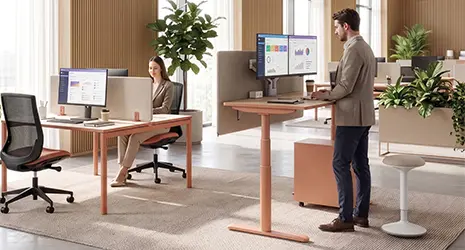
The principle remains the same when standing. Stand upright in front of the desk. Relax your shoulders. Bend your elbows to approximately 90 degrees. The desktop should reach this height.
The screen should remain at eye level. If you are using a laptop, use a stand, a separate keyboard, and a separate mouse.
For a person approximately 1.70 m tall, the ideal standing height is often around 105 to 108 cm. Again, adjust it according to your comfort. A few centimeters can make a difference to your posture.

What height should you choose based on your height? See the reference chart
These values are indicative guidelines. They should be adjusted according to arm length, seat, shoes and user experience.
| Size | Approximate seat height | Approximate standing height |
| 1.60 m | 64 to 66 cm | 95 to 100 cm |
| 1.70 m | 68 to 72 cm | 103 to 108 cm |
| 1.75 m | 70 to 74 cm | 108 to 112 cm |
| 1.80 m | 73 to 76 cm | 112 to 116 cm |
| 1.90 m | 78 to 80 cm | 120 to 125 cm |
The most reliable rule remains simple. Adjust the platform to elbow height. Test it. Then adjust it by 2 or 3 cm if you feel any tension in your shoulders, back, or wrists.
How to adjust your sit-stand desk step by step
- Start by sitting down. Adjust your chair. Place your feet flat on the floor. Adjust the desktop to elbow height. Position the keyboard and mouse 10 or 15 cm from the edge of the desk.
- Next, adjust the screen. The top of the screen should be close to eye level. The distance between your eyes and the screen is generally between 50 and 70 cm.
- Next, stand up. Raise the platform until your elbows are at the same angle. Your shoulders should remain relaxed.
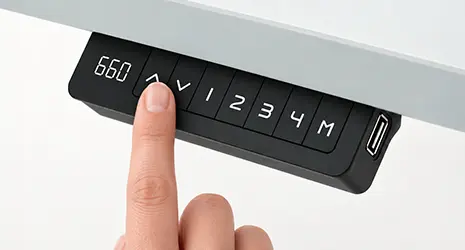
With Envol Evo, the adjustment is electric. The desk adjusts from 63 to 128 cm. The "up & down" control box allows you to memorize 4 positions.
You can therefore save a seated height, a standing height, and two additional settings for another user or another use.
The case also includes a USB A port and a 5V USB C charging port.

How often should you alternate between sitting and standing?
The sit-stand desk isn't meant for standing all day. It's for changing posture. The right rhythm depends on the individual. A simple rule is to change position every 30 to 60 minutes. Start gradually. Stand for 15 to 20 minutes, then sit back down. Increase the time as you find it comfortable. The best posture is always the one that changes.
Choose a desk whose size accommodates all body types
A good sit-stand desk should extend low enough for the sitting position.
It also needs to be high enough for standing. This is even more important in a flexible office environment. Several users may take turns at the same workstation. The desk must be suitable for different body types.
Envol Evo covers a height range of 63 to 128 cm. This range accommodates most seated and standing positions. The motor is integrated into each leg, ensuring smooth and synchronized movement. Envol Evo is available as a single workstation, with a return, and in a multi-workstation face-to-face configuration. The spacing between the platforms also allows for cable management or the addition of an optional central screen panel.
The desk supports up to 120 kg per tabletop, and up to 150 kg for a desk with a return. It incorporates anti-collision safety with a gyroscopic sensor.
The advantages of buronomic for your sit-stand workstations
Buronomic designs and manufactures its professional furniture collections in Honfleur, Calvados, France. Envol Evo embodies this approach: an ergonomic, adjustable, and durable desk designed for new ways of working. It is suitable for individual offices, open-plan spaces, shared workstations, and flexible office environments. For a complete project, Buronomic can assist with the selection of workstations, finishes, accessories, connectivity, and layout.