According to several studies on visitor experience, first impressions are formed in a matter of seconds. The reception area is the only space in a company that speaks to 100% of its visitors. Clients, partners, candidates, suppliers: they all pass through it.
A poorly designed reception area is a missed opportunity. It sends a negative message about the company's professionalism and culture before a word is even exchanged. The cost is never displayed, but it's very real.
With over 45 years of experience manufacturing professional furniture, buronomic has designed collections specifically for reception areas. From reception desks and waiting room seating to acoustic solutions, each piece of furniture is designed for a specific purpose.
This article offers you a complete overview: the essential areas of the reception hall, the selection criteria for each piece of furniture, the legal obligations for people with reduced mobility, the precisely adapted office products and the mistakes to never make.
Why the reception area is a strategic investment for the company
A direct lever on brand image and visitor trust
The reception area is the face of the company. It reflects its values, culture, and level of professionalism at a glance. A well-designed space inspires confidence and credibility even before the first interaction.
Consistency with the rest of the offices is essential. A reception area that clashes with the workspaces creates a dissonance that detracts from the overall image. Visitors immediately perceive the lack of continuity.
An employer branding tool to attract candidates
Candidates form their first impression of a company as soon as they enter the premises. A well-designed lobby sends a clear signal about the quality of work life, the care given to employees, and the company culture.
The coordinated Buronomic collections ensure visual consistency, from the reception area to the workspaces. This unity strengthens employees' sense of belonging and the brand image for visitors.
A functional space for reception staff
The lobby is not just a presentation space. It is also a fully-fledged workstation for reception staff. Ergonomics, storage, visibility of the entrance, badge and document management: these are all functions that must be integrated into the furniture from the design stage.
The essential areas of a well-designed reception area
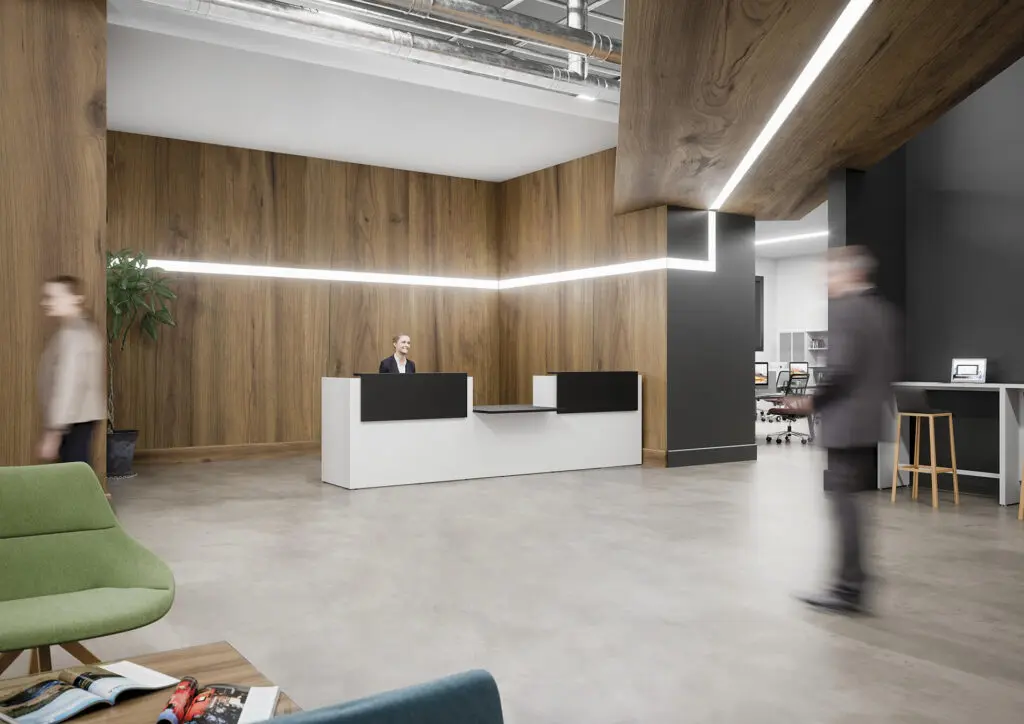
A professional reception area is more than just a reception desk and a few chairs. It consists of complementary zones, each designed for a specific function in the visitor's journey.
Zone 1: The entrance and the exterior-interior transition
The entrance area should allow visitors to find their way around easily, without feeling lost. The recommended distance between the entrance and the reception desk is 3 to 5 meters. This is sufficient for orientation without creating congestion.
Directional signage should be placed at eye level, between 1.60 and 1.80 meters. Sufficient color contrast makes it accessible to visually impaired people. Also consider providing a place to store belongings: a coat rack or luggage area for visitors arriving with suitcases or equipment.
Zone 2: the reception desk, the functional heart and showcase of the company
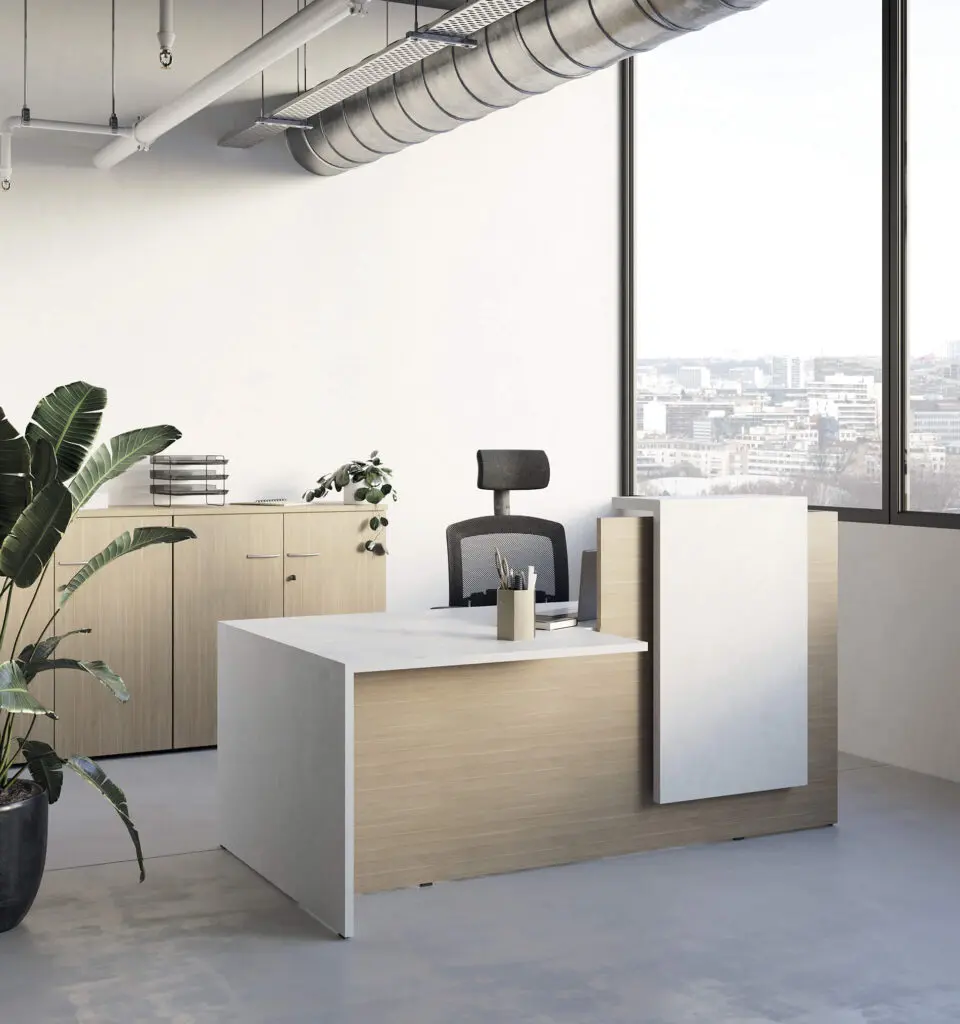
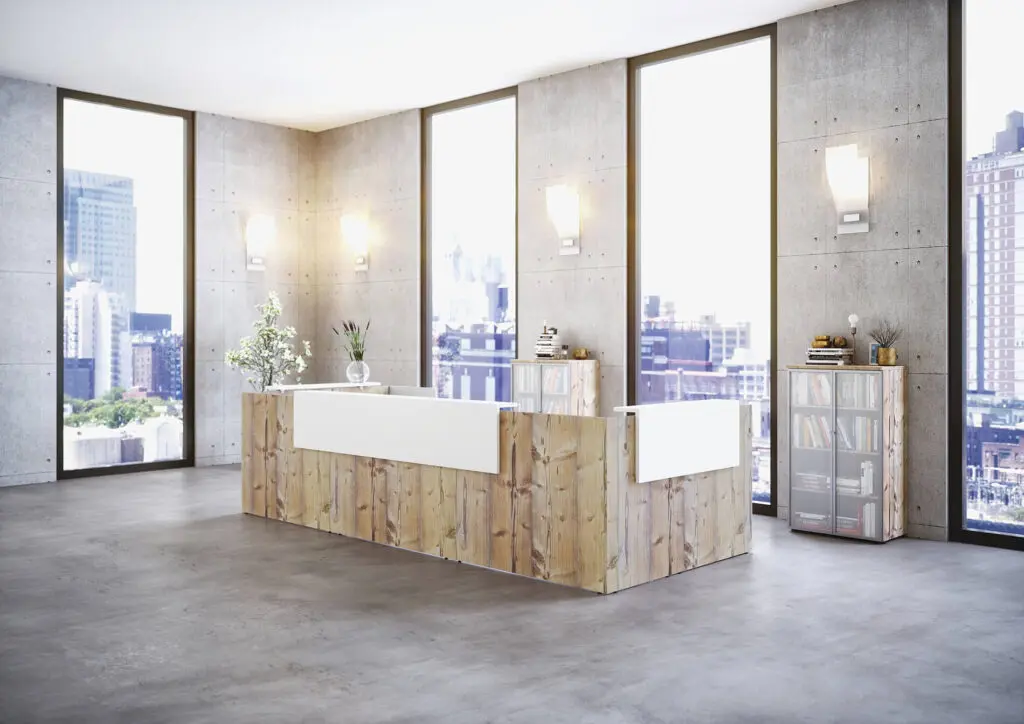
It is the central element of the hall. Positioned opposite the entrance, it ensures a direct and natural view for incoming visitors. Its dual function is clear: an ergonomic workstation for staff, and a visual and functional interface for visitors.
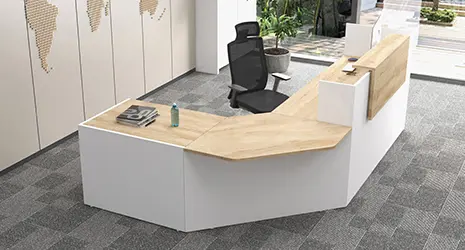
Two heights coexist: 73 cm on the staff side for seated work, ensuring accessibility for people with reduced mobility on the visitor side; and 100 cm on the visitor side for a natural standing reception area. The counter integrates the necessary equipment: screen, keyboards, storage for badges and documents, and connectivity.
In the office furniture sector, two models cover most needs. The reception desk offers a contemporary design with distinct upper and lower sections. The Fifty-Full reception desk provides an expanded configuration, designed for high-traffic areas or larger reception teams.
Zone 3: the waiting area, reflecting the company's hospitality
Waiting time is an opportunity. When well-planned, it enhances the company's image. When poorly planned, it generates frustration and a bad impression.
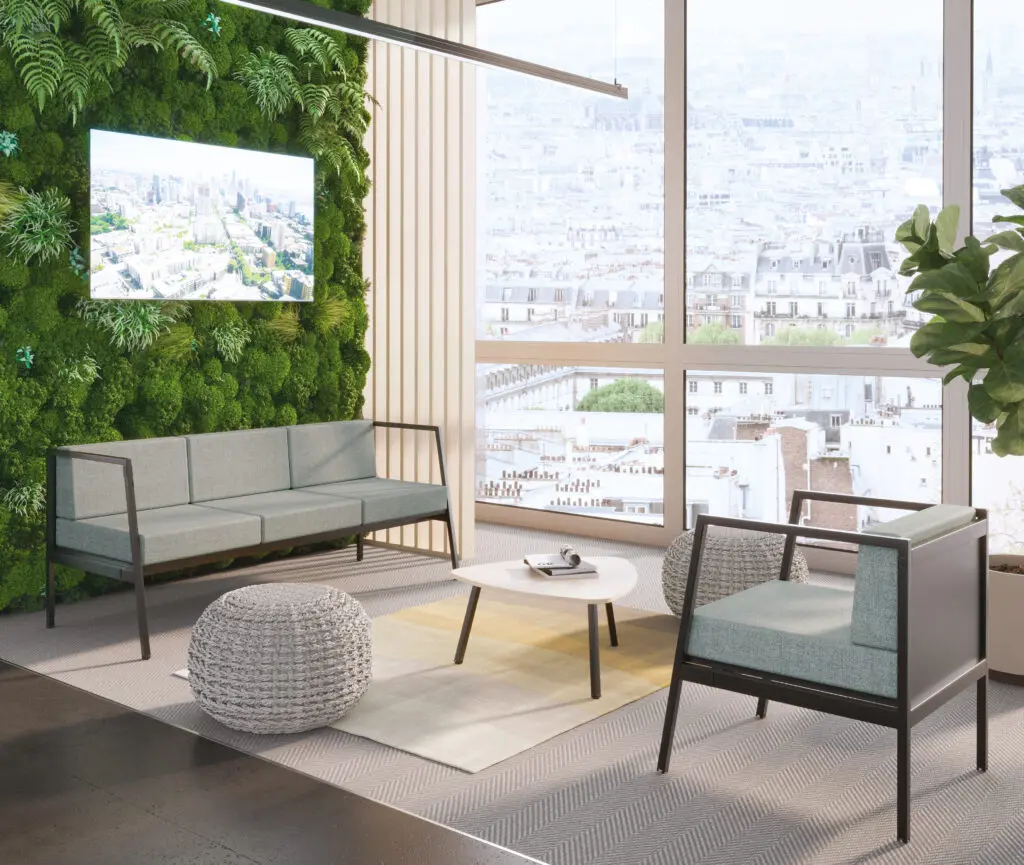
Several elements contribute to a successful waiting area. Comfortable, high-quality seating sends a strong message about the care taken with visitors. Low tables or side tables provide space for coffee, documents, or laptops. Well-organized materials are also essential: displays of company publications, an information screen, and industry magazines.
For office furniture, the Alto collection covers all needs. Two- and three-seater sofas in professional fabric, with organic lines and coordinated finishes. Alto armchairs for individual comfort, available in several fabric colors. Alto side tables, with their wooden tops and metal bases, harmonize with the sofas and armchairs in the range.
Zone 4: the confidentiality zone for sensitive exchanges
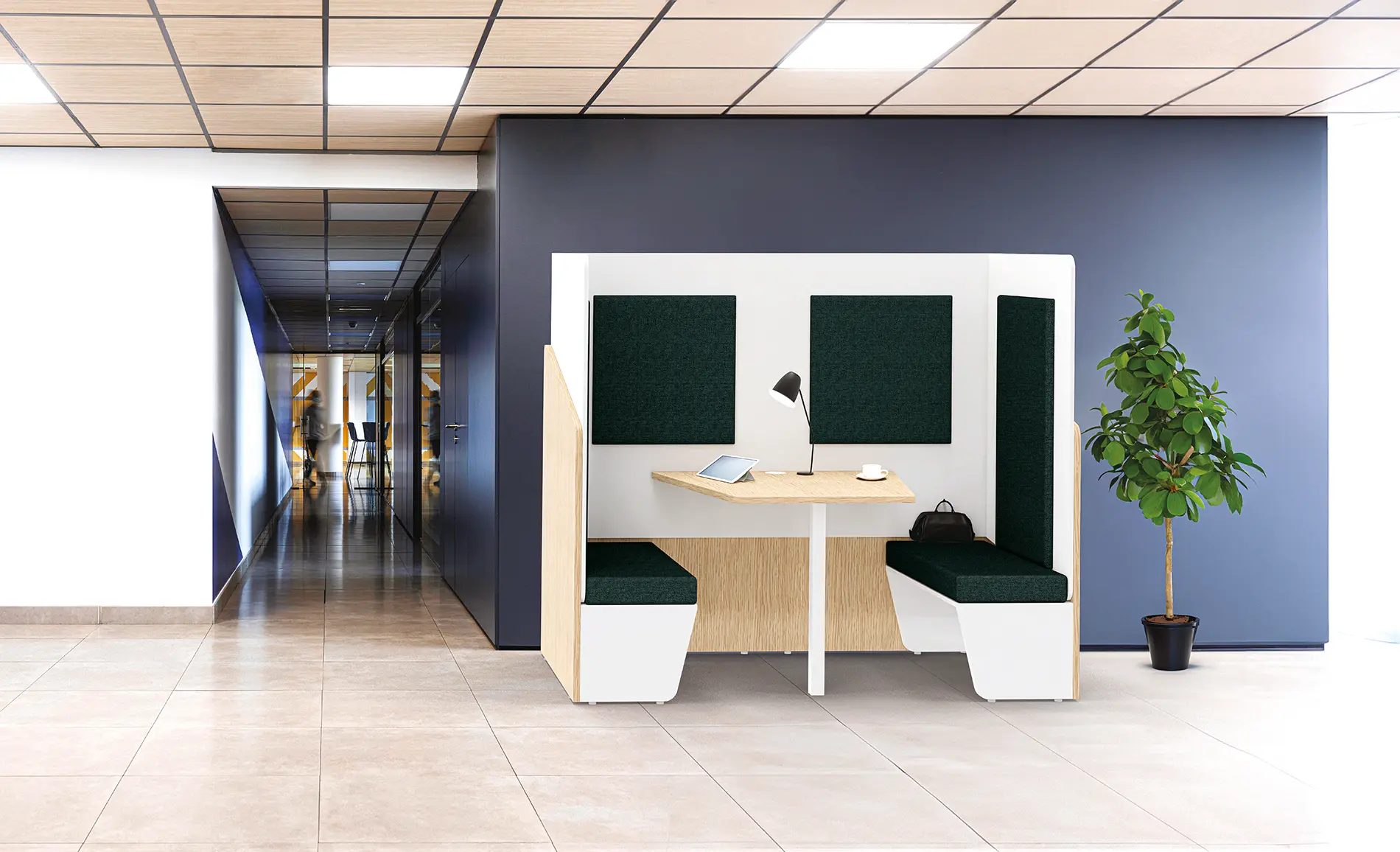
Some visitors arrive for interviews, negotiations, or confidential meetings. They need a space away from the main flow of traffic. An acoustic alcove in the lobby eliminates the need to dedicate a meeting room to these brief exchanges.
The advantage is strategic. The visitor feels valued and protected from the moment of arrival.
The Calme alcoves feature high, enveloping backrests made of absorbent fabric for partial sound insulation. Available in single or double configurations, they fit into spaces of 2 to 4 m².
Reception desk: choosing the right model according to space and intended use
The Fifty-Fifty bank: the balance between standing reception and seated work
Its two-tiered design serves a dual purpose. The upper section, at 100 cm, accommodates standing visitors. The lower section, at 73 cm, provides seated workspace for staff. The lower section, accessible from the visitor's side, ensures accessibility for people with reduced mobility (PRM) without compromising the overall design.
The contemporary design is coordinated with the buronomic office collections, for overall visual consistency.
The Fifty-Full bank: for high-traffic areas and extended reception teams
Its expanded configuration allows several people to be accommodated simultaneously at the counter. It is suitable for high-traffic businesses: head offices, public access buildings, medical or administrative facilities.
It retains the same ergonomic design as the Fifty-Fifty, with an increased work surface to allow for multiple people to work together.
The criteria for choosing between the two models
| Criteria | Fifty-Fifty | Fifty-Full |
| Hall area | Small to medium | Medium to large |
| Reception staff | 1 to 2 people | 2 to 4 people |
| Visitor flow | Moderate | Pupil |
| Accessibility for people with reduced mobility | Integrated | Integrated |
| Positioning | Simple, understated design | Design, representative |
The waiting area: transforming waiting time into a positive experience
Choosing the seating: comfort, durability and visual message
The seating in the waiting area is the visitor's first physical contact with the company's furniture. This first contact matters.
Opt for upholstered fabric. Three combined benefits: superior comfort, passive sound absorption, and professional durability. Vary the formats. A sofa for groups. An individual armchair for privacy. A bench for linear configurations.
In terms of materials, opt for options that are resistant to intensive use: washable professional fabric, sturdy metal base.
The Alto 2 and 3 seater sofas and Alto armchairs are designed for this purpose. Durable, heavy-duty fabric available in several coordinated colors.
Tables: functionality and aesthetic harmony
The coffee tables are placed at seat height, for placing drinks, documents and laptops.
The format remains discreet and uncluttered. In a lobby, the table should not visually compete with the reception desk.
The Alto side tables meet these specifications. Wooden top, slim metal base, dimensions harmonized with the Alto sofas and armchairs.
The acoustics of the waiting area
A reception area is a high-traffic area. Reverberation can quickly become unpleasant for visitors and disruptive for reception staff.
Several solutions exist that don't require construction work. Fabric furniture: Alto sofas and armchairs naturally absorb sound waves. Calme alcoves: for creating private spaces. Bewall partitions: to structure the space without blocking light. A rug on the floor: absorption is significant in a lobby with hard surfaces (marble, concrete, tile).
Legal and regulatory obligations for the reception area
Accessibility for people with reduced mobility: a non-negotiable obligation
For all establishments open to the public (ERP), the reception hall must be accessible to people with reduced mobility.
The reception desk must be of an appropriate height. At least one section must be 73 cm high and accessible from the visitor's side. Buronomic's Fifty-Fifty and Fifty-Full counters incorporate this requirement into their design.
Signage must be adapted for visually impaired people. Chromatic contrast, legible font, height of 1.60 to 1.80 m.
Fire and traffic safety standards
Mandatory exits allow for rapid evacuation of the space. The minimum width of circulation aisles is 90 cm, ideally 120 cm in a high-traffic hall. Fire safety signage is mandatory and must not be obscured by furniture.
Bewall partition walls are designed without floor anchoring. This feature facilitates evacuations and provides flexibility in the daily use of space.
Design and atmosphere: creating a strong visual identity right from the entrance
Define the style before choosing the furniture
Two main directions generally structure a professional reception area.
The understated, minimalist style relies on clean lines, neutral colors, and natural materials. The message conveyed is one of seriousness and rigor.
The warm and welcoming style relies on brighter colors, soft materials, and greenery. The message conveyed is one of openness and dynamism.
The decision must be consistent with the brand's visual identity and the sector of activity. For office furniture, the finishes of the Fifty desks and the fabric colors of the Alto collection are available in several options to suit both departments.
Consistency with the rest of the company's spaces
A lobby that clashes with the offices creates a dissonance that raises questions about the company's coherence. Choose the same finishes and color palettes as in the workspaces.
The Buronomic collections are available in coordinated finishes between the reception collection (Fifty) and the office and storage collections (Envol, Alto, Quiétude). Visual coherence is established from the furniture selection stage.
The colors, the lighting, and the decoration
In terms of colors, opt for neutral and understated tones for the background (white, grey, beige). Add an accent color that aligns with the company's brand guidelines.
The lighting benefits from being layered. General lighting combined with indirect ambient lighting. Dim lighting in the waiting area, direct and functional lighting at the reception desk.
Natural plants offer three key benefits: improved air quality, slight sound absorption, and a calming, welcoming atmosphere. The logo and visual identity find an ideal space in the lobby to reinforce brand recall.
Layout according to the size of the reception hall
| Surface | Configuration | Recommended office furniture |
| Less than 15 m² | Reception desk + 2 to 3 seats | Fifty-Fifty + 2 Alto armchairs + 1 Alto side table |
| 15 to 30 m² | Bank + full waiting area | Fifty-Fifty + 2-seater sofa + 2 armchairs + Alto tables |
| 30 to 60 m² | Bank + waiting + confidentiality | Fifty-Full + 3-seater sofa + armchairs + Calm alcove + Bewall partitions |
| Over 60 m² | Multiple differentiated zones | Fifty-Full + Alto Collection Set + Calm Alcoves + Bewall + Quietude |
Design a small reception area (less than 15 m²)
The Fifty-Fifty reception desk is the priority. Compact yet fully equipped. Place two Alto armchairs facing the desk to provide comfort for visitors without cluttering the space. An Alto side table is all you need for a drink or documents.
The traffic flow rules apply fully in this format. Allow at least 90 cm of free passage on each side of the reception desk.
Create an intermediate reception area (15 to 30 m²)
The Fifty-Fifty or Fifty-Full counter is suitable, depending on the expected visitor flow. The waiting area becomes separate. Plan for one 2-seater Alto sofa, two Alto armchairs, and two Alto side tables.
Bewall partitions allow for the visual separation of waiting areas from traffic flow. No construction work, no anchoring required, and with great reconfiguration flexibility.
Create a large reception hall (over 30 m²)
The Fifty-Full reception desk handles high traffic volumes. The waiting area is expanded with a 3-seater sofa, a 2-seater sofa, and several Alto armchairs.
A private area is perfectly suited to the Calme alcoves positioned around the perimeter. Bewall partitions structure the space into clearly defined zones. Quiétude storage units organize documents and publications available for self-service.
The most common mistakes in designing a reception area
Choosing a reception desk without considering staff ergonomics
The reception desk is a workstation. If the staff isn't comfortable, the reception suffers. Check the seated working height of 73 cm, the legroom, and the accessibility of storage. The Fifty-Fifty and Fifty-Full reception desks from buronomic are designed for both uses simultaneously.
Neglecting accessibility for people with reduced mobility
A reception desk without an accessible lower section is non-compliant for public access buildings (ERP). This requirement applies as soon as the establishment opens to the public: customers, service providers, and visitors with disabilities.
Place the reception desk in the corner of the room
The reception desk must visually monitor the entrance. It should face the main entrance. At an angle, staff cannot see visitors entering, and visitors don't know where to go.
Choosing uncomfortable waiting room seating to save money
The seating in the waiting area is the visitor's first physical contact with the company's furniture. Uncomfortable seating generates frustration that damages the relationship even before the meeting. Investing in professional furniture (Alto Buronomic collection) is more cost-effective than replacing consumer-grade furniture every three years.
Forget about the acoustics of the hall
A lobby with hard surfaces (tiles, glass, metal) amplifies noise and creates discomfort for visitors and staff. Numerous solutions exist that don't require construction work: fabric furniture from the Alto collection, Bewall partitions, floor mats, and Calme alcoves.
Create a reception area that is completely distinct from the rest of the offices
If the lobby is luxurious and the offices austere, visitors will have doubts. If the lobby is austere and the offices tidy, the first impression will be flawed. Consistency is achieved by using the same finishes and Buronomic collections from the entrance to the workspaces.
Frequently asked questions about the layout of a company reception area
What is the ideal height for a reception desk?
On the staff side: 73 cm for seated work and accessibility for visitors. On the standing visitor side: 100 cm for a natural standing reception. Buronomic's Fifty-Fifty and Fifty-Full counters incorporate these two heights in a single piece of furniture.
What waiting room furniture should I choose for a professional reception area?
Sofas and armchairs upholstered in durable, heavy-duty professional fabric. Side tables at seat height for drinks and documents. For office furniture, the Alto collection (2- and 3-seater sofas, armchairs, side tables) comes with a 5-year warranty on seating and a 10-year warranty on coffee tables.
How to improve the acoustics of a reception hall without construction work?
Several strategies can be combined. Fabric furniture (Alto collection) provides passive sound absorption. Bewall partitions delineate areas and reduce sound transmission. Calme alcoves offer private spaces for confidential conversations. A rug on the floor absorbs impact noise.
Does the reception hall need to be accessible to people with reduced mobility?
Yes, mandatory for all public access buildings (ERP). The minimum circulation width is 90 cm. The maneuvering area for wheelchair users requires 150 cm. The accessible counter height is 73 cm on the visitor side, on at least part of the reception desk.
How to choose between the Fifty-Fifty bank and the Fifty-Full bank?
The Fifty-Fifty is suitable for small to medium-sized lobbies, with 1 to 2 receptionists and moderate visitor traffic. The Fifty-Full is designed for large lobbies, with 2 to 4 receptionists simultaneously and high visitor traffic. Both offer the same contemporary design, ergonomics, and accessibility compliance.
What size area should be planned for a professional reception area?
The recommended minimum is 10 m² for a functional individual reception area, with a waiting area for two people. For 5 to 10 simultaneous visitors, allow 25 to 35 m² for adequate comfort. For larger facilities with high traffic, allow 50 to 80 m² with separate zones.
The reception area is the living business card of the company. It forms the first impression in less than 7 seconds and conditions the perception of visitors for the entire duration of their relationship with the company.
Four areas are essential:
- The entrance and orientation.
- The reception desk.
- The waiting area.
- The privacy space.
Three golden rules structure the approach:
- Consistency with the rest of the offices.
- Accessibility for people with reduced mobility.
- Acoustics treated without construction work.