Since the rise of hybrid work, offices are in direct competition with your employees' sofas. A well-designed relaxation area has become one of the key factors in making people want to come to the office.
The figures confirm the importance of this issue. 88% of French employees consider quality of life at work to be of significant importance, according to the Ipsos/Qualisocial 2024 barometer. Harvard/MIT studies go further: a happy employee is 31% more productive.
Quality of life is no longer an HR issue, it's a performance issue.
At buronomic, the relaxation area is not a secondary space. It is an integral part of the "living spaces at work" vision that the brand has championed for over 45 years. It is a key component of a successful professional layout.
This article covers all aspects of the subject: why create a relaxation space, the design steps, the zones to plan, suitable furniture, mistakes to avoid, and Buronomic products for each use.
Why relaxation areas have become a strategic issue for companies
A direct lever on team productivity and creativity
The brain needs to disconnect to function properly. A real break restores concentration and reduces fatigue-related errors. Without a break, productivity plummets by mid-afternoon.
The best ideas often arise from informal exchanges, not formal meetings. A well-designed relaxation area provides an ideal setting for these valuable moments. It also facilitates cross-departmental exchanges between colleagues, strengthening team cohesion and potentially sparking innovation.
A strong signal for employer branding and talent retention
A well-designed relaxation area speaks louder than words in a job posting. It tangibly reflects the company culture and the care given to employees. It's a selling point that's immediately apparent to a candidate during their first visit.
The effect is enhanced by the overall coherence. A relaxation area coordinated with the rest of the offices, using the same finishes and collections, reinforces visual consistency and the sense of belonging among the teams. This is a point that buronomic incorporates into the design of all its collections.
What the law says about rest areas in the workplace
The legal obligation is clear. Companies with more than 50 employees must provide a fully equipped dining area. For companies with fewer than 50 employees, a clean and secure space is sufficient.
One crucial distinction remains. The law mandates a dining area, not a relaxation area. Therefore, the relaxation area goes beyond legal requirements. It's a strategic choice, not simply a matter of compliance.
Steps to designing your relaxation space
Step 1: Consult the teams before starting
Internal questionnaires, co-creation workshops, discussions with employee representatives. There is no shortage of methods to identify real needs.
Needs vary according to generation, profession, and work rhythms. A space designed with the teams is a space adopted by the teams. It's a simple, often overlooked rule that nevertheless determines the project's success in use.
Step 2: Choose the right location
The space must be accessible to everyone, but visually and acoustically separated from the work areas. It is this separation that allows for a true mental break.
Prioritize natural light. Its impact on well-being is direct, measurable, and often underestimated in office design choices. A practical rule of thumb: position the workspace within 100 meters of workstations.
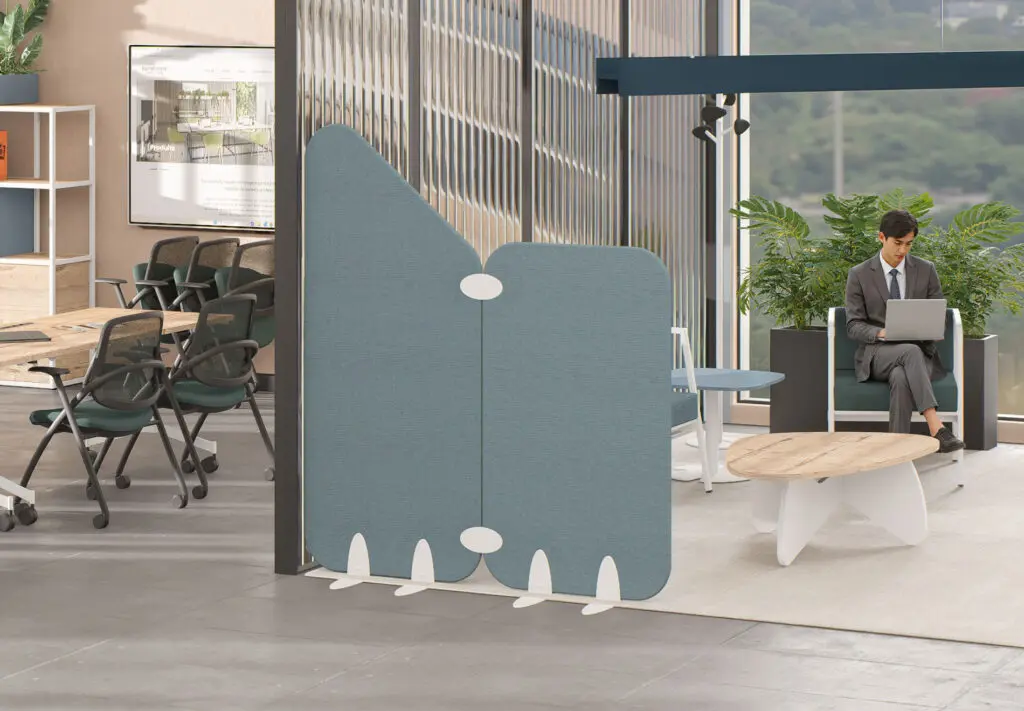
If the space is open to the open-plan office, privacy partitions allow for acoustic demarcation without construction work. No wall fixing is required, and repositioning is possible as the office layout evolves.
Step 3: Define the zones according to their uses
Low seating relaxation area, standing social area, dining area, informal area. Each use calls for its own layout.
The golden rule is simple. The furniture in the relaxation area must be radically different from the furniture in the workspace. It is this contrast that triggers the mental break and allows for true disconnection.
Modularity remains a valuable guiding principle. A space that adapts to different times of day lasts longer than a static layout. It accommodates evolving uses without requiring a complete reconfiguration.
Step 4: Choose the right furniture for each area
Warm materials, colors different from the workspaces, softer and more organic shapes. Each piece of furniture contributes to breaking away from the office environment.
The following section details the furniture zone by zone, with the buronomic references associated with each use.
Step 5: Create the right atmosphere and decor
The colors must be radically different from the workspaces. This is what immediately triggers a mental break for the employee entering the space.
Warm tones (terracotta, yellow, orange) for conviviality. Soft tones (green, blue) for relaxation. Natural plants provide a triple benefit: air quality, light sound absorption, and a soothing atmosphere.
Consistency with the company's visual identity remains essential. However, it's important not to replicate the office atmosphere, which would negate the desired separation effect.
The essential areas of a successful relaxation space
A well-designed relaxation space is not just a sofa in a corner. It consists of complementary zones, each designed for a specific use and a different time of day.
The lounge area: the heart of the relaxation space
This is the central space of the room, dedicated to true disconnection. The seating is low and comfortable, radically different from office chairs. The low tables allow you to place drinks and belongings without settling into work mode.
The atmosphere makes all the difference. Soft lighting, gentle colors, plants: every detail helps to signal that you are leaving the world of work.
The 2- and 3-seater sofas are designed for this purpose. The Alto armchairs complete the look when used individually. The Alto side tables, with their wooden tops, provide the necessary visual warmth. Several fabric colors are available.
The standing social area: for spontaneous exchanges
High tables with stools transform coffee breaks into genuine moments of interaction. The standing format encourages short, dynamic conversations. It's often the busiest spot in the room.
Nuanza high tables are available on casters, allowing you to reconfigure the area as needed. Astrolite high tables offer a more pronounced bar-style design. For seating, the Ara and Détente stools complete the range.
The food court and the coffee corner
The coffee corner is a strategic meeting point. Paying attention to its layout is a priority; it's often where the first conversations of the day take place.
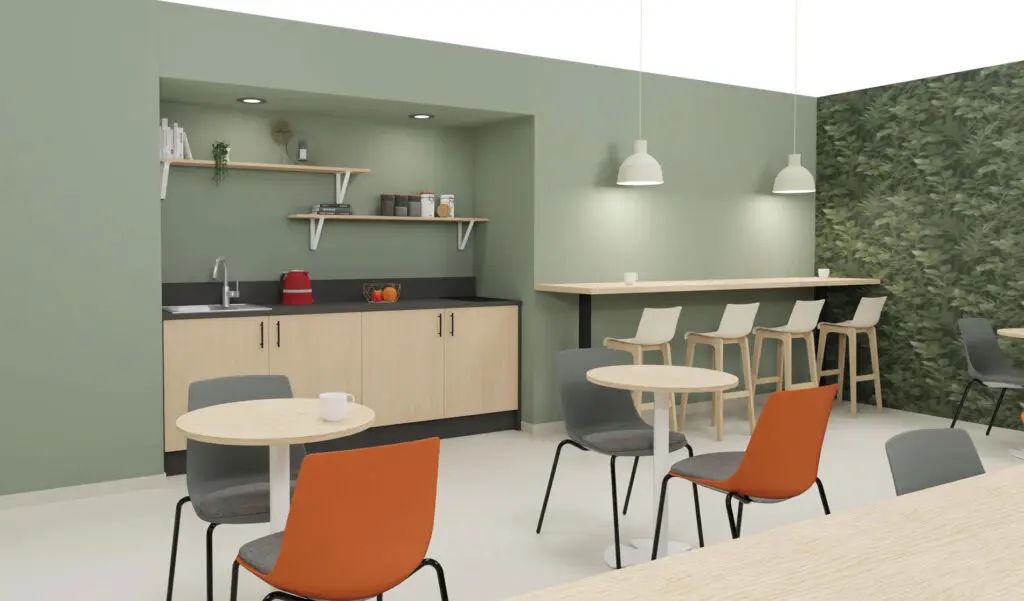
A good kitchenette includes a sink, closed storage, and compatibility with a professional coffee machine. Sufficient clearance around the equipment is necessary to avoid queues during peak hours.
The Oasys kitchenette meets these requirements. Several configurations are available, with or without wall cabinets. The Quiétude storage units with fabric backs complete the organization, serving a dual purpose: functional and acoustic.
The informal meeting and socialization area
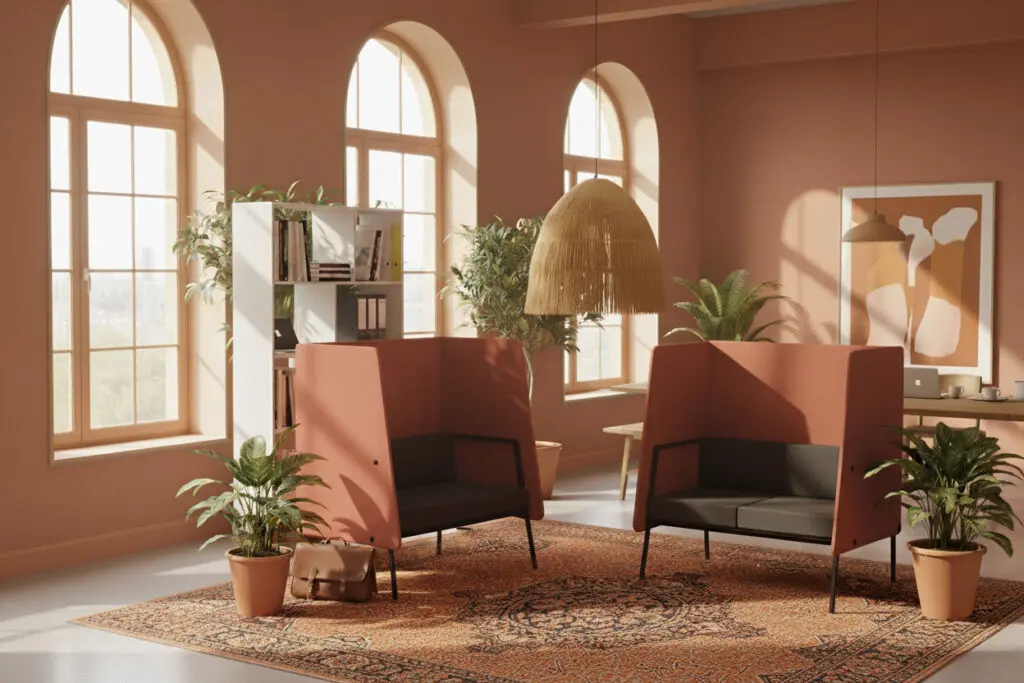
This area addresses a specific need: allowing two or four people to converse without disturbing others. The high, enveloping backrests create a natural acoustic bubble, keeping conversations contained.
It's also a direct alternative to meeting rooms reserved for short exchanges. Faster, simpler, more user-friendly.
For office-style spaces, the Calme alcoves are designed for this purpose, offering a more intimate option. The Alto sofas, arranged face-to-face, allow for more open configurations.

What furniture should I choose for a professional relaxation area?
The furniture in the relaxation area follows a fundamental rule: it must be radically different from the work furniture. This is what makes the mental break immediate and real.
Seating: comfort, variety and absorbent materials
Vary the heights. A low seat for true relaxation, a high seat for dynamic discussions. Also vary the seating arrangements: solo for individual relaxation, grouped for exchanges with colleagues.
Opt for upholstered fabric. It offers three combined benefits: natural sound absorption, superior comfort, and professional durability. A common mistake is to furnish the relaxation area with hard furniture (bare wood, metal, plastic) that reflects sound and increases the overall noise level.
Buronomic offers a wide range of suitable furniture. Alto 2 and 3-seater sofas and Alto armchairs feature professional-grade, washable fabric that is resistant to heavy use. Ara stools are stackable, making them ideal for small spaces. Détente stools are perfect for comfortable standing and socializing.
Tables: modularity and adaptability to different uses
Low tables for the lounge area: they allow you to put things down without setting up a desk. High tables for socializing: they encourage short, dynamic conversations. Tables on casters to adapt the layout to different times of day.
In the office furniture category, the Alto side tables combine a wooden top with a metal base. The Nuanza high tables are available on casters, at a fixed height. The Astrolite high tables offer a mobile bar format. The Détente tables come in several sizes to suit different uses.
The kitchenette: the functional heart of the space
The challenge is to elegantly integrate the catering equipment into a piece of furniture that is consistent with the rest of the design. Closed storage units keep the space clean and tidy. The choice of configuration depends on the available space.
The Oasys kitchenette from buronomic is available in compact or standard versions. With or without overhead storage. Compatible with professional catering equipment.
Dividers and partitions to structure without partitioning
Delineate areas without fixed walls or construction work. Absorb noise and protect the relaxation area from external noise pollution. This is the dual purpose of partition furniture.
Bewall partitions are modular and require no anchoring. Quiétude storage units with fabric backs can be used as acoustic dividers. They are available in a 104 cm height to allow light in, and a 136 cm height for a more defined separation.
Layout according to the size of the relaxation area
| Configuration | Effective | Minimal furniture | Recommended furniture for Buronomic |
| Small relaxation area | Less than 15 people. | Compact sofa, coffee table, coffee machine | Alto 2-seater sofa, Alto armchair, side table, Ara stool |
| Intermediate break room | 15 to 40 people. | Sofas, high tables, kitchenette, partition | Alto seating range, Nuanza, Oasys kitchenette, Bewall partitions |
| Large social room | More than 40 people. | Separate zones, multiple furniture pieces, complete equipment | The Buronomic relaxation collection, Calme and Alto alcoves, and Quiétude storage units |
Creating a small relaxation space: maximizing comfort without cluttering
Furniture with clean lines and light colors visually enlarges the space. Priority is given to furniture on casters and stackable seating.
A typical setup works in spaces as small as 10 square meters. A compact Alto sofa, a side table, and two Ara stools: the relaxation area is ready. The compact version of the Oasys kitchenette integrates all the necessary equipment without cluttering the available space.
Setting up an intermediate break room: creating clearly defined zones
The surface area allows for a distinction between a low lounge zone and a standing social zone. The Nuanza high tables on casters facilitate quick reconfiguration depending on the use.
Bewall partitions delineate areas where work is not required. They also improve the overall acoustics.
Creating a large communal room: a living space in its own right
Several well-defined zones coexist: dining, lounge, standing social area, informal gatherings. The Calm alcoves create more intimate rest areas within the main hall.
The overall aesthetic coherence is ensured by the buronomic collections, designed to be coordinated with each other.
Acoustics, decor and ambiance: the details that make all the difference
Improving the acoustics of the relaxation area without construction work
A relaxation area without acoustic treatment is noisy for those using it and for the neighbors. Two distinct issues to address simultaneously: isolating the space from outside noise and improving acoustic comfort inside.
There are many solutions that don't require construction work. Bewall partitions for separation. Upholstered furniture from the Alto collection for sound absorption. Quiétude storage units with fabric backs used as dividers. Floor rugs to reduce reverberation.
Colors and light to trigger the mental break
The fundamental rule is immutable: Choose radically different colours for the workspaces.
Warm tones (terracotta, yellow, orange) promote conviviality and interaction. Soft tones (green, blue, beige) encourage relaxation and stress reduction. Lighting should be subdued and warmer than in workspaces. Natural plants complement the ambiance, improving air quality, providing slight sound absorption, and creating a calming effect.
Consistency with the company's identity without replicating the office atmosphere
The relaxation area reflects the company culture. It must be consistent with the overall image, without being identical to the offices. This balance is what makes the difference.
Buronomic offers an interior design consulting service that includes personalized color recommendations. Buronomic collections are available in coordinated colors to ensure visual consistency throughout.
The most common mistakes in designing a relaxation area
Install hard furniture that reflects sound
Bare wood, metal, plastic: all these materials amplify noise instead of absorbing it. A noisy relaxation space isn't relaxing; it's counterproductive. The solution lies in upholstered fabric, Alto sofas and armchairs, and a rug on the floor.
Recreate the atmosphere of offices
Same colors, same style of furniture as the offices: no mental break possible. The brain needs a different visual signal to trigger disconnection. The practical rule: at least one radically different color, more organic shapes, softer materials.
Neglecting the acoustics between the relaxation area and the work areas
An open-plan relaxation area disrupts the work of employees working nearby. The solution requires no construction work. Bewall partitions are installed to create a boundary, without any structural modifications, and are immediately reversible.
Create a relaxation area without consulting the teams
A space designed without users is a space that is underutilized. Co-design is simpler than you might think. A 5-question questionnaire is all it takes to identify priority needs.
Undersizing the space relative to the number of employees
One sofa for 50 employees: the break room is always occupied and never truly relaxing. The practical rule: plan for space to accommodate 10% of the workforce at any one time. This is the minimum threshold for the space to deliver on its promise.
The relaxation area is no longer a secondary space. It is a lever for productivity, team cohesion and employer branding.
Five steps structure a successful project: Consult the teams. Choose the right location. Define zones according to their uses. Select the appropriate furniture. Pay attention to the atmosphere and decoration.
Four areas are essential. The lounge area for true relaxation. The standing social area for spontaneous conversations. The dining area for coffee breaks and meals. The informal meeting area for more focused discussions.
One fundamental rule runs through everything. The furniture in the relaxation area must be radically different from the furniture in the work area. Warm and absorbent materials. Distinct colors. More organic shapes.